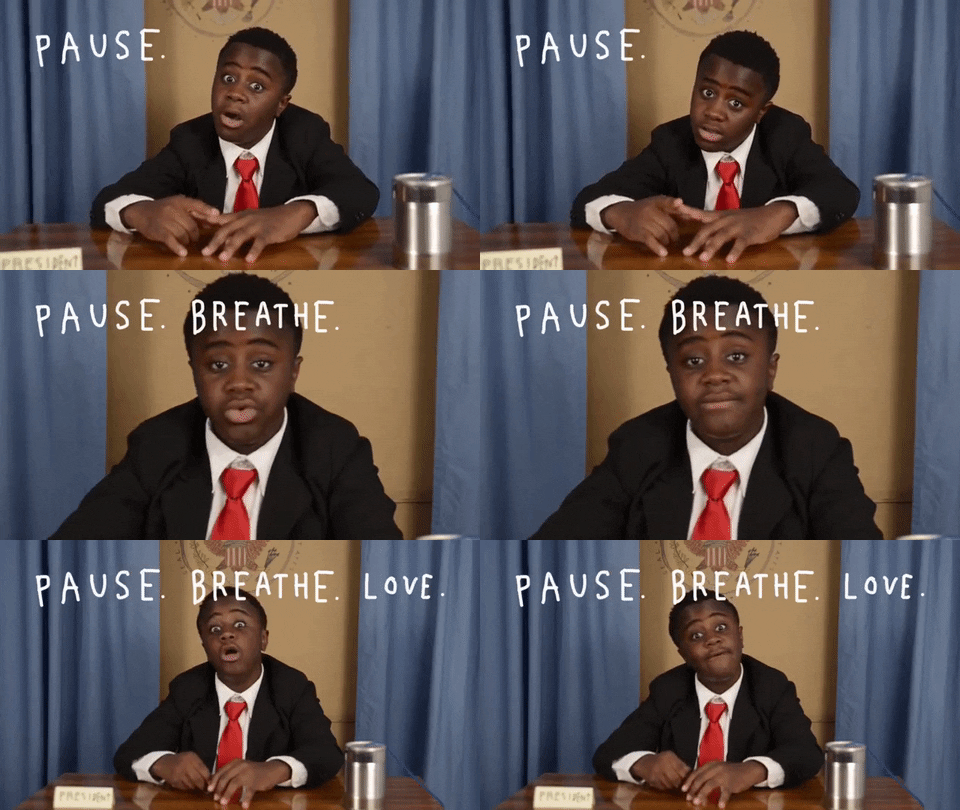
The end is near. The end of 2019, that is. Have you taken stock of what's important? I have.
Right now I'm holding a doll. A doll my kindergartener gave me with instructions to "hold her while she sleeps." And as I type these words, I hear in the background my twelve-year-old son (today is his birthday) giving instructions to his new game Exploding Kittens. My 16yo son is practicing vocals for the high school musical tryouts for West Side Story. My second grade daughter squeals as she practices handstands for tumbling, and Mom is asking all the kids about their day at school. My teenage girls are scrolling their screens and watching God knows what!
Sometimes I lose myself. This blogpost deadline came around so fast, I can hardly believe it. Since my last post, we buried my father-in-law, had a blizzard that cancelled our Thanksgiving travel plans to see family, found lice in one of our children's hair, and I only wrote a few thousand new words (including a picture book manuscript). Wow. I'm getting tired.
Sometimes I wonder if I can offer useful advice through our blog. My craft understanding took a big leap when I got into Pitchwars in 2018, but I still am in the early stages of my understanding of writing a complete novel. But bear with me. Because, I can offer something useful.
Still, I have to be honest. Trying to write full-time while managing a busy family of nine sometimes pushes me close to the depressive episodes I've struggled with in years past. This is where I am right now.
While I want to write awesome and unputdownable middle grade stories, I need to recognize the real life demands I face. As a husband to a successful physician (Chief of staff and director of OB at our regional hospital) and wonderful mother, I owe her and our children my fullest attention. My writing will continue, as I can fit it in (I have seven full manuscripts of my 2018 Pitchwars novel out with agents and am working on several new manuscripts), but I am first and foremost a husband and father. I will not cede those responsibilities to others.
Please remember that you are not your writing. You are more than what other people think of your writing - or any of your accomplishments for that matter. I'm trying to remember that too. And though the writing dream lives within me, I will remember everything that's important to me. I hope you will too.
This may be my last blog post for a while, but I'll keep my writing dreams alive. Please keep your dreams alive, too. As this year comes to an end, remember that you are more than any one label you or anyone else might apply. You are an individual. You are capable of great things. Follow your heart. Listen to it. Trust it. You will be fine. So will I.
Rob
Showing posts with label writing. Show all posts
Friday, December 13, 2019
Friday, October 11, 2019
Fall Hashtag Challenges for Readers and Writers (Or, Ways to Ensure you will Never Leave Your Burrito Blanket Again!)
![]() |
| via Inspirexpress.com |
Dark and chilly fall days can make you want to curl up in
your burrito blanket and eschew all human contact and activity forever. Because GACK! *small
talk* and EERK! *doing things*!
Yes, these shorter days can suck the
motivation right out of one’s soul. And for writers, lack of motivation may elicit painful bouts of writing dialogue as stale as the Lucky Charms marshmallow I found in my shoe yesterday.
Don’t ask.
But there is help out there for the seasonally-challenged
reader or writer...participating in a Twitter-community challenge! It may not
cure your acute case of writerly SADD, but it can give you a swift
kick in the motivation caboose, along with all the feels of a virtual group hug. Even if you're not on Twitter, you can search out the prompts to use on your own or participate via host websites. These challenges also allow you the flexibility to participate just one day or every day. So, JUST SAY NO when sloth-like tendencies set in or the Harry Potter movie marathon airs again. And again. Here are several legit hashtags (and one fake) to consider following this fall:
#MGbooktober,
hosted by MGBookVillage:
Follow this hashtag for quirky daily prompts to get you thinking about your
favorite middle grade characters and storylines, as well as to find recommendations for some new great reads!
#finishurbookfall: An accountability hashtag for writers who don’t care about spelling “you’re”
like “ur” (*fans face, swallows antacid*), this one keeps you honest about your writing productivity and may even push you towards finishing a
current project by December 21st.
#anodetocandycorn: For
those who live for the day when these triangular conglomerations of pure sugary joy
are finally put back out in stores each year, this is the hashtag to follow for
writing 250-character poems, stories and odes to the nemesis of dental hygiene!
#inktober2019,
@inktober: This tag is actually for
illustrators -- encouraging them to whip up new creations each day from a one-word
prompt. However, readers and writers may enjoy this one, too. As someone who has trouble drawing a recognizable smiley face, I follow
along just to witness the sheer daily genius, which acts as an added dose of inspiration!
#writethewait:
Originally created for those individuals submitting work to Pitch Wars (a contest which
matches writers with author mentors, which is happening NOW) this hashtag can be used any time you're "writing through the pain" of
waiting for responses from contests/editors/agents/critique partners or even for
the Friends reunion movie to finally be a thing. (Please?!)
#mgspookytober
via Spooky MG: Chime in here about your favorite middle grade villains and creepiest sleepover stories! You can also visit the corresponding website year-round, because "Spooky books aren't just for Halloween anymore!"
#turtlewriters,
@turtlewriters – Are you a speed-impaired
writer even on your best autumn days? Follow this handle or hashtag for weekly prompts and endless encouragement. Truly, these writing turtles are always supportive (and never snappy)!
#nanowrimo: Finally, most
writers know about National Novel
Writing Month, where the goal is to write 50K words during the month of November (which BTW, is a perfect amount for MG writers!). But this organization sponsors writing challenges and chats, and provides prep and pep squads year-round.
***
There are literally dozens/hundreds/quad-million other reading and writing hashtag challenges to follow (not to mention those found on Instagram, Facebook and other social media platforms), but hopefully one or more of the above will encourage you to begin unraveling yourself from your doldrum cocoon. And if you guessed that #anodetocandycorn was the fake hashtag…Congratulations! (But don't you wish it was real?) Happy fall, all!
Friday, June 21, 2019
Dear Writer, Be Healthy
You're a writer. You make time to write even if your life is busy. It's what you do. I applaud you for that. And now it's confession time.
I don't write every day. I don't even read every day.
I'd like to write and read every day. But I don't. Not anymore. These days, I try to give myself a little more balance. I try to keep my personal priorities straight. (God knows with seven active school-age children I'm lucky to not forget who goes where when. I mean, there's dance, baseball, tennis, horseback-riding, Jiu Jitsu, etc...)
Writing and reading are fit into my busy and ever-changing schedule as necessary. Yeah, I'm a slow writer, and tend to knock off chunks of projects at a time when I can. But not at the cost of family time or my own personal health anymore.
I learned that the hard way. Ever since a depression diagnosis a few years ago, I've struggled at times with the things I love.
I've learned, and I hope you will too, that taking care of yourself is the only way you can continue to do the things you love. The only way you can be your best self. The only way you can give yourself a chance to write - or do anything you enjoy.
When my depression took hold, it wrecked my ability to do the things I'd enjoyed. And it took the joy from all the things I did.
Lucky for me, my wife is a physician. She recognized that I was in trouble and she helped me get the care I needed.
Give yourself permission to take a break now and then. Maybe even move your bar a little if you're feeling overwhelmed with the demands you put on yourself. Step back. Be still. Shut out the noise. Then try to listen to yourself. And by all means, reach out for help or guidance if you are uneasy and think you might be in an unhealthy situation.
There is no limit to the number of barriers, obstacles, and distractions that can keep us from writing - or living the life we should live. That will probably always be true. But please, bear in mind what's at stake when your life feels out of balance. Find yourself again. Be you. Be the best you that you can be.
Also, I love you. I hope you write the best book you can write and that I get to read it someday. And I hope you will take care of yourself so that can happen. I'm rooting for you.
Take care,
Rob
I don't write every day. I don't even read every day.
I'd like to write and read every day. But I don't. Not anymore. These days, I try to give myself a little more balance. I try to keep my personal priorities straight. (God knows with seven active school-age children I'm lucky to not forget who goes where when. I mean, there's dance, baseball, tennis, horseback-riding, Jiu Jitsu, etc...)
Writing and reading are fit into my busy and ever-changing schedule as necessary. Yeah, I'm a slow writer, and tend to knock off chunks of projects at a time when I can. But not at the cost of family time or my own personal health anymore.
I learned that the hard way. Ever since a depression diagnosis a few years ago, I've struggled at times with the things I love.
I've learned, and I hope you will too, that taking care of yourself is the only way you can continue to do the things you love. The only way you can be your best self. The only way you can give yourself a chance to write - or do anything you enjoy.
When my depression took hold, it wrecked my ability to do the things I'd enjoyed. And it took the joy from all the things I did.
Lucky for me, my wife is a physician. She recognized that I was in trouble and she helped me get the care I needed.
Give yourself permission to take a break now and then. Maybe even move your bar a little if you're feeling overwhelmed with the demands you put on yourself. Step back. Be still. Shut out the noise. Then try to listen to yourself. And by all means, reach out for help or guidance if you are uneasy and think you might be in an unhealthy situation.
There is no limit to the number of barriers, obstacles, and distractions that can keep us from writing - or living the life we should live. That will probably always be true. But please, bear in mind what's at stake when your life feels out of balance. Find yourself again. Be you. Be the best you that you can be.
Also, I love you. I hope you write the best book you can write and that I get to read it someday. And I hope you will take care of yourself so that can happen. I'm rooting for you.
Take care,
Rob
Monday, January 28, 2019
The Vault
I think this post will serve as a good counterpoint to my last one, which saw me feeling somewhat discouraged but ready to plug ahead at my own pace, once that pace revealed itself. It did just that a couple of weeks ago.
I was having a conversation that somehow meandered its way into writing. Some brainstorming ideas were tossed around, somewhat jokingly at first, but a few things stuck. I started getting that feeling that one of those ideas was coming to life a little stronger than the others, so I rode with it for a few days.
Like so many other writers, I have a Vault. That place we keep the ideas that we might be able to use someday. Maybe they don't feel right for what we're working on at the time, but maybe someday they'll come in handy. It's probably more accurate to say I have three vaults: A mental one up in the old noggin, a digital one spread out over at least three hard drives, and a physical one made up of two big cardboard boxes kept in my office. These boxes contain notes and stories and doodlings and lists I decided at some point not to throw away. Some of them go back decades.
I spent an evening digging those vault boxes, and found a puzzle piece that clicked right into place with all the other loose pieces rattling around in my head. From there, I thought back to a moment about a year ago when I noticed some details about a landmark I know well that made me curious.
Soon a story was putting itself together. I started coming up with random character points and lines, and collecting notes on my phone to keep from forgetting them. Before I realized it had happened, I had a rough outline put together, including an ending.
The message of today's lesson? Respect the vault. Keep the notes. Write things down, somewhere. You never know when that random idea will come in handy.
I was having a conversation that somehow meandered its way into writing. Some brainstorming ideas were tossed around, somewhat jokingly at first, but a few things stuck. I started getting that feeling that one of those ideas was coming to life a little stronger than the others, so I rode with it for a few days.
Like so many other writers, I have a Vault. That place we keep the ideas that we might be able to use someday. Maybe they don't feel right for what we're working on at the time, but maybe someday they'll come in handy. It's probably more accurate to say I have three vaults: A mental one up in the old noggin, a digital one spread out over at least three hard drives, and a physical one made up of two big cardboard boxes kept in my office. These boxes contain notes and stories and doodlings and lists I decided at some point not to throw away. Some of them go back decades.
I spent an evening digging those vault boxes, and found a puzzle piece that clicked right into place with all the other loose pieces rattling around in my head. From there, I thought back to a moment about a year ago when I noticed some details about a landmark I know well that made me curious.
Soon a story was putting itself together. I started coming up with random character points and lines, and collecting notes on my phone to keep from forgetting them. Before I realized it had happened, I had a rough outline put together, including an ending.
The message of today's lesson? Respect the vault. Keep the notes. Write things down, somewhere. You never know when that random idea will come in handy.
Monday, July 2, 2018
Writing from Reading
I started writing a new manuscript last week. It was kind of a spontaneous moment, just thinking about what I’d like to work on and encountering half an idea, which was just enough to get me curious. I put in about 2,000 words and felt pretty good. I also started reading a new middle grade book last week. I’d just finished one, and with the kind of time on my hands that summer break can provide, I wanted to get right into something new.
My middle grade To Be Read pile for the summer is extensive; truthfully, there are likely more books there than I’ll have time to finish (isn’t that always the case?). I sorted them into piles to try and narrow down which would be the best to take on next:
*Books that were considered classics that I’d never gotten around to reading before
*Books I’d bought because of the online buzz they’d received
*Books the media teacher at school had passed on to me
*Books that I knew little about, but somehow found intriguing
*Books that promised broad and fantastic adventures
The pile I spent the most time considering was the intriguing one. What was it about these books that had caught my interest? What, if anything, did they have in common? I looked through the titles, I read the descriptions on the back, and started to put some things together. Each of the books from the intriguing pile had something that reminded me of what I hoped the one I had just started writing would be like.
A common piece of writing advice that gets passed around is to write what you know. I would never take on writing a piece of heavy science fiction or high fantasy because those are genres I haven’t read extensively. Maybe staying inside your comfort zone as a writer can mean playing things too safe and that might not always be a the best way to challenge ourselves and learn.
However, don’t a lot of us end up trying to write the kinds of books that we think our younger selves would’ve liked to read, or even did read? How much of the stories we choose is guided by the stories we know? It seems like a “chicken and the egg” kind of thing: Do we write the books we choose because of the ones we’ve read, or do the books we write guide us to the ones we’d like to read?
I still don’t know which book I want to read next, by the way, but I’ve narrowed it down to two: THE SAME STUFF AS STARS by Katherine Paterson, or SEE YOU IN THE COSMOS by Jack Cheng. I was drawn to each because of the personal journeys taken by their characters. That both of them are somehow related to space is just a coincidence.
At least I think it is. I was pretty big into astronomy when I was a middle grader….
My middle grade To Be Read pile for the summer is extensive; truthfully, there are likely more books there than I’ll have time to finish (isn’t that always the case?). I sorted them into piles to try and narrow down which would be the best to take on next:
*Books that were considered classics that I’d never gotten around to reading before
*Books I’d bought because of the online buzz they’d received
*Books the media teacher at school had passed on to me
*Books that I knew little about, but somehow found intriguing
*Books that promised broad and fantastic adventures
The pile I spent the most time considering was the intriguing one. What was it about these books that had caught my interest? What, if anything, did they have in common? I looked through the titles, I read the descriptions on the back, and started to put some things together. Each of the books from the intriguing pile had something that reminded me of what I hoped the one I had just started writing would be like.
A common piece of writing advice that gets passed around is to write what you know. I would never take on writing a piece of heavy science fiction or high fantasy because those are genres I haven’t read extensively. Maybe staying inside your comfort zone as a writer can mean playing things too safe and that might not always be a the best way to challenge ourselves and learn.
However, don’t a lot of us end up trying to write the kinds of books that we think our younger selves would’ve liked to read, or even did read? How much of the stories we choose is guided by the stories we know? It seems like a “chicken and the egg” kind of thing: Do we write the books we choose because of the ones we’ve read, or do the books we write guide us to the ones we’d like to read?
I still don’t know which book I want to read next, by the way, but I’ve narrowed it down to two: THE SAME STUFF AS STARS by Katherine Paterson, or SEE YOU IN THE COSMOS by Jack Cheng. I was drawn to each because of the personal journeys taken by their characters. That both of them are somehow related to space is just a coincidence.
At least I think it is. I was pretty big into astronomy when I was a middle grader….
Friday, June 15, 2018
This is Not a Pasta Spoon: Repurposing Tools of the Trade to Get the Job Done (a post for writers… no, seriously)
Top shelves of kitchen cabinets were not located with short
cooks in mind. I can’t reach the top shelves, but I need the storage space, so
those top shelves are full of stuff anyway. I’m too independent to rely on the
taller members of my family, too stubborn to haul a chair or step-stool across
the room every time I need to reach something, and so…the pasta spoon.
I don’t
believe I’ve ever once used it to serve spaghetti, but gosh, it makes an
excellent reacher! Those slightly-curved prongs tuck around all manner of
packages on my top shelf so I can easily nudge them to the front and let them
drop into my waiting hand. Repurposing the pasta spoon is efficient and
effective for me.
I’ve repurposed tools of the trade in writing, too, and
today I want to share one of those with you, in the hopes you’ll also find it
efficient and effective.
The pitch. We writers
often don’t consider pitching our story until…well, until we’re pitching it. We
write, revise, and polish our manuscript, and then suddenly it’s time to send
it out into the world in search of a home, and we realize we need a query
letter – which of course is basically a pitch, designed to make the recipient need to read our story. But there’s much
to be gained from repurposing the pitch.
What if, instead
of using the pitch as a query tool, you use it as a guide. What if, instead of writing
the pitch after your manuscript is finished, you write it before. Write it when
you’re in that heart-pounding yes, this! stage
of discovering your story, to bring focus and clarity to your
awesome-but-probably-a-tad-vague idea. Write it then, and use it to keep you on
track. Use it to guide you, to keep one hand on the through-line of your story as you work your way toward the end.
Odds are, you’ll want to tweak the pitch when you finally get to the query
stage, but that’s okay—the time you spend writing a pitch now will save you a
ton of time in revisions later.
Depending where you are on the plotter—pantser spectrum, the
idea of writing the pitch before writing
the story may or may not seem comfortable, easy, or even feasible. Plotters, maybe
you already write the pitch first. Maybe you’re saying, hey, I’ve always used the pasta spoon for that. But pantsers, I
know it doesn’t feel natural. I know you’re probably thinking but I don’t know until I write the story! I
understand…I’m with you. But try it. Really.
If you’ll allow me to throw in a completely different
metaphor here... *tosses culinary tools back in the drawer, because who am I kidding,
I’m no chef* Imagine you’re driving on the prairies. You can see your destination
a long while before you’ll get there. You can drive straight for it, of course,
but what if you’re a pantser? What if you want to wander through wheat fields and
explore dusty backroads along the way? Keeping your pitch in mind as you write
is like glancing up regularly at that grain-elevator goal in the distance, shimmering
on the horizon, so whatever route you take, you’re moving steadily toward where
you want to be.
Have you repurposed your pitch this way before? Are there other
writing tools of the trade you’ve repurposed? I’d love to hear what you’ve
found to be effective and efficient for you in your writing. Please share!
Labels:
amwriting,
pitches,
the writing life,
writing,
writing tips
Monday, May 7, 2018
Finding Your Voice
We all know it when we read it, but how much we enjoy it can also be a very subjective thing:
The novel's voice.
When querying to get an agent, problem with voice is some of the most common feedback an author can receive:
Thank you for giving us a chance with this. I’m sorry to say I don’t think it’s one for me. While this has some nice points, when I take a on a new project I need to feel such a strong connection to the voice, I’m afraid I’m not quite there with this. Of course, it’s a really subjective business. Another agent may well feel differently. (an actual rejection letter I received in early 2014)
Thank you for sending me your query. I am sorry not to invite you to submit your work or to offer to represent you. The material just didn’t grab me, and you deserve an unequivocally enthusiastic agent as your advocate. (another actual rejection letter!)
Sometimes, authors' submissions get rejected because of the plot — for example, submitting a book in which the heroine falls in love with a vampire or a book discovers he's actually a wizard — most often it's not the book's plot, but the author's voice.
Other books, I pick then up and can't stop reading. And in many cases, that's not simply because of an excellent plot or a well-formed characters, it's because of the author's voice.
For example, I could read Erin Entrada Kelly all day long. Her latest book, YOU GO FIRST, sang to me from the first paragraph onwards:
Twelve-year-old Charlotte Lockhard balanced an unopened Dr. Pepper upright on her hand and thought: This is what it feels like to hold my dad's heart.
Same as the Dr. Pepper.
Brilliant huh? Well, she is the most recent Newbery Medal winner, so no great surprise there.
How about Jason Reynold's fantastic voice in GHOST:
CHECK THIS OUT. This dude named Andrew Dahl holds the world record for blowing up the most balloons . . . with his nose. Yeah. That's true. Not sure how he found out that was some kind of special talent, and I can't even imagine how much snot be in those balloons, but hey, it's a thing and Andrew's the best at it.
These authors and their characters do not sound remotely alike, but you know straight away that these are characters you want to get to know. And you can tell you are in the hands of experienced authors who make the cadence of their words a joy to read.
Easy for them, you think. How do I make my own voice better?
First of all, YOUR voice is your way of looking at the world. And while your characters' voices will change from book to book, once you mast voice, your readers will always have a sense that they are reading a book by an accomplished author with a point of view.
How can you improve your voice?
1. READ VORACIOUSLY
Sometimes I run into authors who don't read in their genre. Which a) I don't really get at all, since I assume that if you want to be a middle grade author you love middle grade books; and b) doesn't allow them the opportunity to learn from other authors.
My best advice is to read widely within your genre, with a special focus on award-winning or critically acclaimed books, and an equal dash of the popular.
Early on, I'd even copy a page out of a particular book, so I could get a sense of the cadence, or rhythm of the story. I highly recommend this, because it will help you with your writing immensely.
2. READ YOUR WORK ALOUD
Everyone tells you to do this, but not everyone does this. It is critical. When you read your work out loud, you immediately find the awkward syntax, the boring bits, the unresolved nature of your writing. I also read drafts on my kindle. For some reason, seeing it in book form makes a tremendous difference to how I perceive my own work.
3. KNOW WHAT YOU WANT TO SAY
Early on, writers stumble around in the dark, unsure of how specific to be. Their work lacks thematic direction and that shows in their voice. The more you understand what it is you want your story to convey, and who you think in the story should convey it, the easier it will be to find your voice.
4. EAVESDROP!
Yes, I know it's not polite to listen in on conversations, but if you're writing about eleven year old girls, you're going to want to get a handle on them. I've been known to wander the mall and pause now and then to listen to a bunch of kids talking. And though I remember my own kids at that age very well, I also rely on my friends' kids, too.
And finally:
5. KNOW WHO YOUR CHARACTERS ARE
In my latest book, I have a girl from 1915 who cannot sound like the kids from 2018. At the same time, there are things about being twelve or thirteen years old that will always be universal. The most important thing is to know who your characters are. What do they love, hate, worry about, are afraid of, and cherish? What motivates them? Are they shy or boisterous? Are they frustrated or happy-go-lucky. Your characters' personalities and the kind of story you are telling (see #3) will shape the right voice for your story.
In the end, it all comes down to writing with authenticity and clarity, and then writing and writing and writing in order to make your work as excellent as it can be. If you do all that, I promise: your writer's voice will strengthen!
Good Luck!
Monday, March 19, 2018
Dear Middle Grade Minded: How to Write for Middle Grade
We had a reader send in a question not long ago. It seemed like a great opportunity to remind people if they want to send in questions, we’re more than happy to try answering them.
Hello -- Can you recommend an online writing class for me? I have a good idea for a middle grade book but no experience in writing for this age group. Thanks
First of all, congratulations! Having a good idea is at least half the battle. However, this does lead me into a few rhetorical questions that hopefully will give you some helpful things to think about:
How familiar would you say you are with middle grade literature? Why do you think this is a good idea for middle grade?
When we were discussing the original question, Shari Green brought up an excellent point: “I've no idea if there are any decent classes, but of course the best ‘class' for learning to write middle grade is reading lots and lots of middle grade!” This is one of the most fundamental rules out there about writing, period: You have to know the audience you’re writing for. Middle grade is much more than just books with characters in a certain age range. Middle grade literature has to have something that will capture the attention of a kid growing up in a screen-infested world. It needs to have elements the reader can relate to. It needs to entertain them on their level, but without talking down to them. This isn’t always an easy balance to achieve. The more familiar you are with the books that successfully make all of this happen, the more informed you’ll be about how to approach your own story.
How much writing experience are you starting with?
Are you looking for a writing class as a first step in learning how to write a book? Do you want some guidance on how to write something more specific to a middle grade audience? Unfortunately I don’t have any list of classes to share (maybe someone else will and might post ideas in the comments), and I’m certainly not discounting writing classes, online or otherwise, as a good way to learn about the craft. However, the big truth about writing is the best way to learn how to do it or to get better at it is to WRITE. Young Michael Jordan practiced basketball for endless hours. When Bruce Springsteen was starting out, he played show after show after show. Stephen King probably used up more typewriter ribbons than he could count before he made his first professional sale. Everyone has to start somewhere, and has to put in the time to developing their skill, and, in the case of writers, finding their voice. Whether or not you ever find the type of class you’re thinking about, go ahead and start writing that book! Put that idea to work. Find out there are parts of it you love and parts you hate, then keep working at it and making it better. That’s all any of us can do.
I don’t want to leave you hanging without anything more than the “read more/write more” tips, so I do have a few suggestions. There are hundreds of books about writing out there, which can be more than a little daunting to consider. Here are three writing books I would personally recommend:
ON WRITING by Stephen King
I know a lot of writers who refer to this one as a favorite. I think it’s fair to call it essential.
BIRD BY BIRD BY Anne Lamott
Another thoughtful writing manual/memoir that I’ve always found similar to ON WRITING. They’re both helpful on their own, and they complement each other well.
THE CRAFT OF REVISION by Donald Murray
I was assigned to read this in a college class. Even though we were meant to read it from the perspective of improving academic writing, I found it incredibly valuable beyond that. Most real writing happens during revision, and this is one of the most thoughtful books about the mechanics involved I’ve even encountered.
I’d also suggest to dig deep into Twitter, and follow different authors, agents, and editors who post threads about craft and process. You can find some interesting points to consider if you keep your eyes open.
Good luck!
Hello -- Can you recommend an online writing class for me? I have a good idea for a middle grade book but no experience in writing for this age group. Thanks
First of all, congratulations! Having a good idea is at least half the battle. However, this does lead me into a few rhetorical questions that hopefully will give you some helpful things to think about:
How familiar would you say you are with middle grade literature? Why do you think this is a good idea for middle grade?
When we were discussing the original question, Shari Green brought up an excellent point: “I've no idea if there are any decent classes, but of course the best ‘class' for learning to write middle grade is reading lots and lots of middle grade!” This is one of the most fundamental rules out there about writing, period: You have to know the audience you’re writing for. Middle grade is much more than just books with characters in a certain age range. Middle grade literature has to have something that will capture the attention of a kid growing up in a screen-infested world. It needs to have elements the reader can relate to. It needs to entertain them on their level, but without talking down to them. This isn’t always an easy balance to achieve. The more familiar you are with the books that successfully make all of this happen, the more informed you’ll be about how to approach your own story.
How much writing experience are you starting with?
Are you looking for a writing class as a first step in learning how to write a book? Do you want some guidance on how to write something more specific to a middle grade audience? Unfortunately I don’t have any list of classes to share (maybe someone else will and might post ideas in the comments), and I’m certainly not discounting writing classes, online or otherwise, as a good way to learn about the craft. However, the big truth about writing is the best way to learn how to do it or to get better at it is to WRITE. Young Michael Jordan practiced basketball for endless hours. When Bruce Springsteen was starting out, he played show after show after show. Stephen King probably used up more typewriter ribbons than he could count before he made his first professional sale. Everyone has to start somewhere, and has to put in the time to developing their skill, and, in the case of writers, finding their voice. Whether or not you ever find the type of class you’re thinking about, go ahead and start writing that book! Put that idea to work. Find out there are parts of it you love and parts you hate, then keep working at it and making it better. That’s all any of us can do.
I don’t want to leave you hanging without anything more than the “read more/write more” tips, so I do have a few suggestions. There are hundreds of books about writing out there, which can be more than a little daunting to consider. Here are three writing books I would personally recommend:
ON WRITING by Stephen King
I know a lot of writers who refer to this one as a favorite. I think it’s fair to call it essential.
BIRD BY BIRD BY Anne Lamott
Another thoughtful writing manual/memoir that I’ve always found similar to ON WRITING. They’re both helpful on their own, and they complement each other well.
THE CRAFT OF REVISION by Donald Murray
I was assigned to read this in a college class. Even though we were meant to read it from the perspective of improving academic writing, I found it incredibly valuable beyond that. Most real writing happens during revision, and this is one of the most thoughtful books about the mechanics involved I’ve even encountered.
I’d also suggest to dig deep into Twitter, and follow different authors, agents, and editors who post threads about craft and process. You can find some interesting points to consider if you keep your eyes open.
Good luck!
Monday, September 4, 2017
Things that leap from the shadows
My husband and I have made a few trips “down island” lately,
most recently yesterday afternoon. Driving back up island just after sunset, we
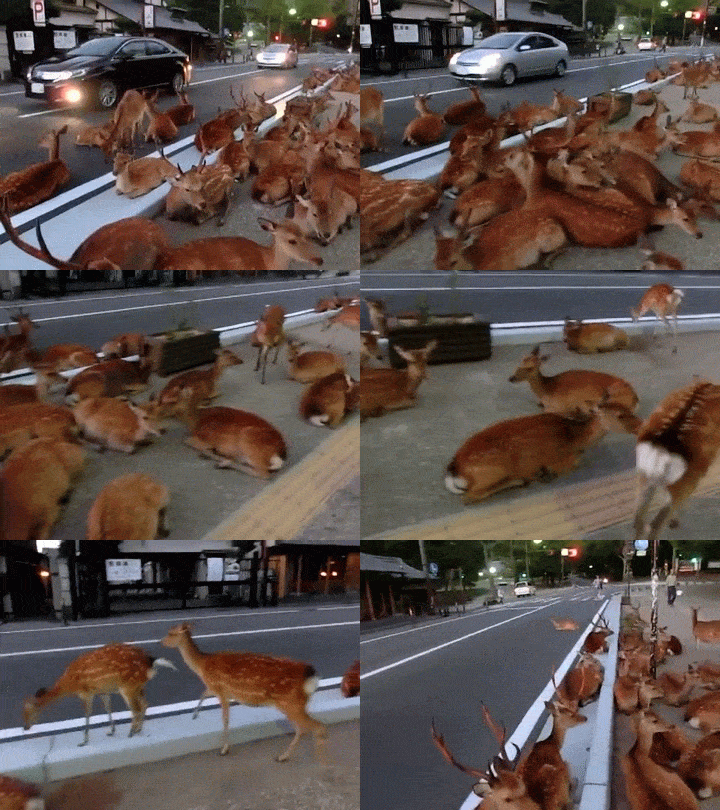
settled in for a couple hours of extreme vigilance. See, there are a lot of deer on the island, and that
early-evening, waning-light time of day seems to draw them to the roadsides,
where they graze on the dry grass and leap out at random to cross the highway.
![]() |
| We may not have quite this many... ;) |
My
hubby hit a deer a couple years ago, on this same drive (the deer lived, but
the car had over $2000 damage and was in the shop for a week), and he and I
have both had close calls at other times. So, we’re cautious, doing whatever we can to prevent
an incident that, at best, would result in minor damage to the deer and our car,
and at worst, would be…well, much worse. We reduce our speed, avoid that hard-to-see
time of day when possible, use the high-beam lights, and constantly scan for
deer.
This morning I’m thinking about vigilance—not for dangers of
the wildlife-encounter sort, but for dangers that can leap from the shadows
along our publishing journeys and completely derail our writing. But what
dangers are there, and how can we guard against them?
- Comparison. Comparison is a joy-killer, a confidence-killer, a creativity-killer, an all-round nasty villain. We have got to remember that we are on our own journey, that someone else's path is not our path. When we're tempted to compare timelines, numbers of rejections, size of advance, sales numbers, or any other "measure", just...don't. And on those days when that stuff keeps landing in front of our face, let's turn comparison on its head, and instead of feeling bitter or jealous or defeated, let's choose the “rising tide lifts all boats” mindset. Another person’s success does not take the place of our own…it may even pave the path and open the door. Those celebrity deals and blockbuster sales? They allow the publisher to afford to offer deals to debut authors, to take a financial risk on unknown writers. And those I’m-happy-for-her-but-she’s-got-what-I-want situations when another writer finds success? Let them motivate us to improve our craft or finish our work, and let them remind us that it is possible, that good things do happen to struggling writers. And then cheer and be thankful to witness their success, letting it buoy us up along the way.
- Ill-conceived goals. It's always discouraging when we fail to achieve a goal, but when our goals are "ill conceived" in the first place, we're really putting ourselves in harm's way, setting ourselves up for a major crash. Ill-conceived goals are ones that are based on things largely out of our control. We cling to them, but we may be confusing goals with dreams. We can dream of a six-figure deal, or signing with a great agent, or winning an award, but beyond writing the very best book we can and sending it out into the world, this stuff of dreams is mostly out of our hands; but the writing, the revising, the seeking feedback and improving our craft, the sending it out, and sending it out again…that’s in our control. So let's base our goals on those things: finish a draft by x date, write x number of words per day or week, research and query half-a-dozen agents on our next day off from the day-job, brainstorm ten new story ideas, participate in NaNoWriMo this year, finish and polish our WIP in time for the next Pitch Wars, save enough money to attend a nearby conference. These goals may not sound as fabulous as the dreams, but we can only hope to someday reach those dreams if we put in the hard work to achieve those building-block goals.
- Negative self-talk. We often tell ourselves things we would never dream of telling a friend or critique partner: your writing will never be good enough; you’ll never get a book deal; you may as well give up now. And even after we’re published, imposter syndrome has us continuing to send such messages: you’re a fraud; your success is a fluke; you’ll never be able to write another book. Those messages can sap our creative energy in no time. I’m not suggesting we should be cocky writer-brats, but we do need to believe in ourselves and in the value of our work. If our story matters to us, it will matter to someone else. Somebody out there needs the stories only we can tell. So tell them. Tell them the very best way we know how, in the way that is uniquely ours, and send them out into the world. The world needs what we have to offer.
- Looking backward. All writers—even those “overnight bestsellers”—have been rejected, disappointed, discouraged. We’re allowed to feel those things. They’re hard, and they hurt. But when we dwell on them, wallowing for far too long, we’re robbing ourselves of joy and stomping on our creative spirit. Who can write when we feel that lousy? I say, limit that shit. Allow ourselves to feel the sting for an hour, or a day if we must, but then move on. Learn what we can from the experience, then leave it behind. Onward!
Labels:
comparison,
Goals,
publishing,
self-care,
the writing life,
writing
Friday, June 30, 2017
Breathing Room: Or, what the ocean taught me about pacing
If you’ve been hanging around me or my social media sites much at all, you
know I love the ocean. One of the things I love about it is how it always
changes. Last week on one of my beach-walks, the ocean was quiet. No wind, so
no waves – no crashing over the rocks, barely even any noticeable gentle-breaking
against the shore. The gulls were strangely quiet, too. Perhaps they’d already
had a good feed and were snoozing somewhere while their breakfast digested. In
all that absence of noise, the sound I became aware of was the scritch
scritch of crabs scurrying about under the rocks.
This was a very different experience than the beach on a stormy day – wind howling past my ears, surf pounding relentlessly against the rocks. The ocean on a stormy day is all about power, and not so much about subtle scritch scritching.
It’s not just the water that changes, of course. Every day the driftwood has been rearranged and new flotsam and jetsam has been offered up. There’s always some new shell or stone or piece of sea glass to catch my eye. And have you noticed how different the air smells at low tide than at high tide? All these things – the changing sights, sounds, smells – keep the beach interesting and make me want to go back again and again (and I do!).
Recently I was thinking about pacing in fiction. And just as a walk by the ocean every single day might get dull if things never changed, if it was predictable, if there was never anything new to grab my attention, so it is with fiction. If scene after scene is the same pace, I’m likely to put the book down. If it's all fast, I get tired; if it's all slow, I get bored. But if it changes, if it has both quiet moments that allow me to discover hidden treasures, and dramatic moments that take my breath away by their power or action or suspense, then I keep reading.
The variety in pacing comes naturally if you use an “action/reaction” or
“scene/sequel” structure when you’re writing and revising. If you’re not quite
so intentional while you’re first-drafting (like me), just think of pacing as
giving readers time to breathe after those scenes that make them hold their
breath.
Those slower scenes shouldn’t put your readers to sleep, however. You’ve likely heard the advice to “leave out the boring parts”. Think about it – which parts do you skip when you’re reading? Probably excess backstory, or some “set-up” or exposition that somehow missed getting cut during revisions. If it’s not essential, leave it out.
So what can go in the slower scenes? Each scene still has to move things forward plot-wise or character-development-wise, but the quieter scenes likely contain things such as:
- a character reacting to what just happened
- the aftermath of an action
- description or essential backstory
- introduction or continuation of a sub-plot.
If the ocean never changed…well, truth be told, I’d probably keep going to the beach, lol. I just love it that much. But if the pacing in a story never changes – whether it’s constantly fast, or constantly slow – I’m probably going to close the book. Want to keep me reading? Make me hold my breath, then give me time to breathe.
Friday, May 19, 2017
A Tough Question: how much are you willing to change for success?
Being published is a dream for so many writers, and each story is important to us. We want this story to be read, we want people to love it. We want to see it on bookshelves. (We wouldn’t be putting ourselves through this agony if we weren’t passionate about getting our book published.)
But… the book is also important to us. The characters have meaning. What happens to them is important! (Most of us wouldn’t be able to go through all the work to write and edit a book if we didn’t LOVE the story and characters.)
So what happens when publishing doesn’t agree with the story you have completed? What if, in order to reach the dream of being publishing you have to change something you don’t want to?
This month, I worked as a mentor for #teenpit, where high school writers submitted some of their writing to be mentored by some awesome writers. During the process, my mentee asked me this super deep question about choosing art or business.
We were discussing a possible shift in perspective of her book and she asked me this:
“No matter what I do, I know that if I took the whole thing [insert suggested book changes here] it'd be a million times more marketable, and I'd have a better chance at being published… And I don't want to deviate from my story just because I want to appease the industry, but at the same time, this is my story, and I want more than anything to see it in the world.”
Oh man. That’s a seriously heavy question!
How much are we willing to change to be published?
It’s a very personal question. For some people the answer may be “EVERYTHING! I’ll do whatever it takes to be published!” for others it may be “Nothing! I won’t change for you!” (In which case, I suggest self-publishing). But for most of us the answer is going to be somewhere in-between.
I don’t have a definite answer for you—only you can answer this question for yourself— but I do have some advice that might help if you’re ever in this predicament.
This was my response to my mentee (with a few tweaks to make it less specific, more universal):
"I went through a long R&R process with Entangled for my first book. We totally re-plotted it. It meant an almost total rewrite. I was okay with the changes because it made the book stronger. But there was one thing my editor suggested that I didn't agree with.
There's a scene at the end of the book that my editor wanted to cut. I took a long time to think about it and decided I wasn't willing to cut it. That scene felt like such an important part of Anna's story and honestly, it fit the new focus of the story (A huge theme was about her lying, this was her big moment of telling the truth. Even facing the truth). I told him I wasn't willing to cut it, and he said we'd make it work (a relief because I was really willing to walk away from the deal for that scene). When he read the final version he said he teared up during that scene.
My suggestion is for you to decide what the heart of this story is for you and stick to it. What don't you want to lose?
For me is was Anna. Is was her journey, her emotions, and her sweet relationship with Jackson (though he used to be Arney. They changed his name!) Everything else in the book could change, but so long as those emotions stayed, I felt confident about it.
What is that thing for you?"
It's a hard line to find sometimes. You will need to change things to be more marketable, that’s just part of publishing and if you want to be successful in traditional publishing, it’s a thing you will have to do. BUT this is your story. Please don’t ever forget that YOU make these choices. And it’s okay to walk away from a situation that you feel uncomfortable with, even if it means walking away from a potential publishing deal.
Finding the line you aren’t willing to cross... that parts up to you. It isn’t always easy but you’ll feel better if you are willing to compromise without losing the heart of your writing and story.
Good luck!
Friday, March 10, 2017
Take What You Need
Last weekend I had the good fortune to gather with eight other
writers at an old (potentially haunted) stone manor house for a three-day
writing retreat.
![]() |
| English Inn, Victoria, BC - photo by Kate Boorman |
It proved to be an excellent location—stunning common areas,
rooms that were both beautiful and comfortable, quirky closets and hallways,
and, only a short walk away, the Pacific Ocean and a park with curious, abandoned military structures. The manor ghost stopped by from time to time, occasionally knocking from
within the walls and causing unplugged phones to ring, but that only added fuel
to our already-out-of-control imaginations. Top it off with good food, shop
talk, wine, and chocolate, and you’ve got a near perfect retreat.
Each of us spent the majority of our time retreating in our rooms – for me, that
meant hours spent fleshing out a new story idea; others were revising or
first-drafting; a few were working together on a joint project; and one person
was intentionally resting, nurturing her creative spirit in preparation for the
heavy workload she knew was ahead. We all did what we needed, what was right
for us at the time. It was bliss.
So, writers should all just zip off to a retreat whenever they feel
the need, right?
Yeah, I think it’s safe to say, for most of us that’s not
gonna happen very often. Before last
weekend, it had been four years since I’d managed to get away for a writing
retreat. (Too long!) But here’s the thing: it’s vital that we recognize and claim whatever we need to be healthy and
productive in our creative lives. Maybe that means indulging in the luxury
of a weekend away from all other commitments, but more often than not, it means carving
out time in bits and pieces amidst multiple responsibilities.
Whether you’re on deadline and need to get words on the page
pronto, or you’re feeling a little battle-worn and desperate for some self-care—wherever
you’re at in this creative life right now—carve out the time and space you need.
Value your work, and nurture your
creative spirit, even if you damn near have to perform miracles to find the
resources to do so.
I know it’s hard, especially when we have so many demands on
our time, energy, and finances, or when we’re so used to caring for others and
putting our own needs on the backburner. Do it anyway. Use that trusty
imagination of yours to come up with a plan to meet your own needs. Yes, your
writing is worth it. Yes, you are
worth it.
Give and Take: Of course, the flip side of "take what you need" is "give what you can". Got a tip on ways to find time to write, or ways to make self-care a priority? Please share! Having a particularly difficult time claiming what you need? Let us know, and maybe the hive-mind of our comments section can help you brainstorm a solution.
Take care, dear writers, and write on.
Friday, February 17, 2017
Why I Write Middle Grade
A Wholesome Escape
When I was growing up, C.S. Lewis regularly lured me into
Narnia, all the way through high school. Every finals week, in fact. Battles
with witches and hags involving grand forces of good and evil really broke up
the monotony of studying.
Middle Grade fiction has a great capacity to draw readers in and
entertain them for the rest of their lives. We all nurse a soft spot for our
favorite early novels. They provided an escape from the sometimes harsh
realities of life and an introduction to new places and ideas.
I'm a kid at heart and easily relate to 8-12 year olds. They’re fun, silly,
inquisitive, and apt to pop off with unexpected comments and connections. When I teach creative writing to 4th and 5th graders, their insightful questions and wild imaginations always keep
me on my toes. The middle grades are a crucial time of development, where tweens
are discovering their interests and trying out new aspects of their
personality. I love working with and writing for this age group because it’s a
chance to help them see themselves as brave, courageous, loyal, and strong.
Middle Grade Fiction Inspires

My favorite MG novels taught me to believe in myself. If Karana could use her wits and courage to survive alone on the Island of the Blue Dolphins, I could use mine to solve drama between friends. If Meg from A Wrinkle in Time managed to save her father and brother from an evil telepathic brain, I could build love in a family torn apart by divorce.

I still relish the wonder found in MG novels, how they tackle tough issues in ways 8-12 year olds can understand. And frankly, the rest of us, too. Who hasn’t cried their way through Bridge to Terabithia, only to find peace at the end?
This is what I hope to create as a MG writer, books that
enchant young readers, drawing them into a lifetime of reading. Books that
inspire and motivate, opening their minds to whole new worlds.
Middle Grade is a time of wonder, a time of discovery, where
our understanding of the world expands. What better time to explore
fictional worlds as we’re struggling to understand our own? And who ever outgrows
that struggle?
When I first started writing, I experimented with various genres,
trying to find the right fit. Then my husband said, “Why don’t you write what
you love?”
Well, now I do and I couldn’t be happier.
A Little About Me
My pen name is R. H. Roberts, but you can call me Renee. I'm Mom to seven awesome kids who don't mind eating burnt pizza when I'm writing (or so they say). I love cats, monsters and the sea, but not necessarily all together. Whenever I can, I SCUBA and snorkel to research for my upcoming underwater fantasy novel. I'm thrilled to join the blogging team here at Middle Grade Minded! Come say hello at my blog.
SaveSaveSaveSave
Subscribe to:
Posts (Atom)