Showing posts with label the writing life. Show all posts

Friday, June 15, 2018

This is Not a Pasta Spoon: Repurposing Tools of the Trade to Get the Job Done (a post for writers… no, seriously)


Top shelves of kitchen cabinets were not located with short cooks in mind. I can’t reach the top shelves, but I need the storage space, so those top shelves are full of stuff anyway. I’m too independent to rely on the taller members of my family, too stubborn to haul a chair or step-stool across the room every time I need to reach something, and so…the pasta spoon. 

I don’t believe I’ve ever once used it to serve spaghetti, but gosh, it makes an excellent reacher! Those slightly-curved prongs tuck around all manner of packages on my top shelf so I can easily nudge them to the front and let them drop into my waiting hand. Repurposing the pasta spoon is efficient and effective for me.

I’ve repurposed tools of the trade in writing, too, and today I want to share one of those with you, in the hopes you’ll also find it efficient and effective.

The pitch. We writers often don’t consider pitching our story until…well, until we’re pitching it. We write, revise, and polish our manuscript, and then suddenly it’s time to send it out into the world in search of a home, and we realize we need a query letter – which of course is basically a pitch, designed to make the recipient need to read our story. But there’s much to be gained from repurposing the pitch.

What if, instead of using the pitch as a query tool, you use it as a guide. What if, instead of writing the pitch after your manuscript is finished, you write it before. Write it when you’re in that heart-pounding yes, this! stage of discovering your story, to bring focus and clarity to your awesome-but-probably-a-tad-vague idea. Write it then, and use it to keep you on track. Use it to guide you, to keep one hand on the through-line of your story as you work your way toward the end. Odds are, you’ll want to tweak the pitch when you finally get to the query stage, but that’s okay—the time you spend writing a pitch now will save you a ton of time in revisions later.

Depending where you are on the plotter—pantser spectrum, the idea of writing the pitch before writing the story may or may not seem comfortable, easy, or even feasible. Plotters, maybe you already write the pitch first. Maybe you’re saying, hey, I’ve always used the pasta spoon for that. But pantsers, I know it doesn’t feel natural. I know you’re probably thinking but I don’t know until I write the story! I understand…I’m with you. But try it. Really.

If you’ll allow me to throw in a completely different metaphor here... *tosses culinary tools back in the drawer, because who am I kidding, I’m no chef* Imagine you’re driving on the prairies. You can see your destination a long while before you’ll get there. You can drive straight for it, of course, but what if you’re a pantser? What if you want to wander through wheat fields and explore dusty backroads along the way? Keeping your pitch in mind as you write is like glancing up regularly at that grain-elevator goal in the distance, shimmering on the horizon, so whatever route you take, you’re moving steadily toward where you want to be.

Have you repurposed your pitch this way before? Are there other writing tools of the trade you’ve repurposed? I’d love to hear what you’ve found to be effective and efficient for you in your writing. Please share!


Friday, March 2, 2018

In which I tell the truth—the whole truth


Recently my Facebook “memories” told me I’d signed the contract for my first middle-grade book exactly two years ago. A couple months from now, my third middle-grade book will make its way into the world. Three books in a little over two years. Whew! In the midst of all the writing, revising, waiting, celebrating, stressing, promoting, doubting, and hoping, I’ve been thrilled and humbled to have my books land on some good lists and even win an award. It’s been a whirlwind. An amazing, I-can’t-believe-this-is-happening whirlwind. But here’s the thing:

If Facebook were to tell the whole story, you’d also know that just over two years ago, none of this had happened. Just over two years ago, I’d acquired an impressive and, truth be told, daunting number of rejection letters. I’d been dropped by my agent. I’d been in the “zero request club” in PitchWars. I’d wrestled with separating writing from publishing, so the roller-coaster ride of being in this industry wouldn’t completely crush my creative spirit. I’d had to dig deep in my battle-worn heart and answer the question, Is this worth it? I’d had to decide whether or not I had it in me to keep hoping.

That hard stuff doesn’t tend to make it onto Facebook. Yes, I’m guilty of putting forth a curated life on social media. (I have my reasons, but I’m not sure they’re good ones.) And so those who look, see part of the truth. And it’s not only with the writing side of things – it’s personal stuff, too. You see the celebrations, the sunny days, the happy-moments snapshots. But I don’t often share the less-great things – the devastating news, the loss and grief, the stress and hurt and disappointment. Truth is, these past two years have had all that in the mix, too.

Where am I going with this? I’m not even sure. But I’ve been thinking lately that social media, with all its good news, yay-hooray curated snippets of people’s lives, can sometimes have the unintended result of discouraging others. So today, in telling the whole truth about my journey (albeit in a very abbreviated form), I hope to say this: Hang on. Keep hoping. The road can be long and hard, but your good news might be around the next corner, or the one after that (but in the meantime, hey--did you see that sunrise? notice that weird twisted tree?). 

Embrace the journey that is uniquely yours, with its mountaintops and dark valleys, long hard paths and surprising vistas. Connect with others who are walking a similar road--we're in this together! Celebrate together, weep together, share the load. Trust that the journey is worth it, and don’t give up.

Monday, December 11, 2017

Balancing Work and Writing


Some writers are lucky enough to be a full time writer. But even writers who write full time as their job have other priorities like family, errands, housework etc. And for those of us who still have a part time or full time job on top of our writing careers, sometimes it seems impossible to juggle everything and still find time to write.

The first thing that helps me balance my full time job and my writing is prioritization. Do I have any deadlines? Projects that need to be turned into a publisher, editor, agent, or even a blog I try to prioritize first. Next I look at my self-imposed deadlines. I’m very goal oriented so saying I want to finish a manuscript edit or drafting something by a certain date usually helps me prioritize things as well.

But…

Sometimes you have to follow the muse. Sometimes your brain is clogged for some reason and won’t let you work on that deadline project. It’s okay to take a break and work on something that’s really speaking to you. Follow those thoughts for a little bit then come back to your deadline. Sometimes that time away helps clarify why the deadline project isn’t flowing and gives you some new perspective.

Another thing that helps me keep moving forward with my writing projects is having set writing time. Once a week I meet up with local writers and we sit at a coffee shop and we write. Sure we talk and share ideas and talk through plot bunnies, but we also write. That’s my guaranteed writing time, and I very rarely let anything trample that time. It’s mine and no one else can have it.

It also helps to realize that just because you aren’t writing words on the page doesn’t mean you aren’t writing. You may not be drafting a new manuscript, but writing an outline, brainstorming, world building, working on character development, editing, thinking about your story and what’s working vs not all counts as writing. Just because the word count in your manuscript doesn’t go up (or even if it drops) doesn’t mean you aren’t writing. All these things contribute to the success of the end product.

And last but not least, give yourself a break. You can’t do it all. Any progress should be celebrated. It’s not easy to work then come home and sit down to write something. Some days it’ll be there and other days it won’t. If you have to skip a day because the words aren’t coming or you really want to do something else, that’s okay. Your brain needs down time just as much as it needs active writing time.

So that’s my list. What other things help you as a writer stay focused on the task while trying to balance life, a job, family and other things?

Monday, September 4, 2017

Things that leap from the shadows

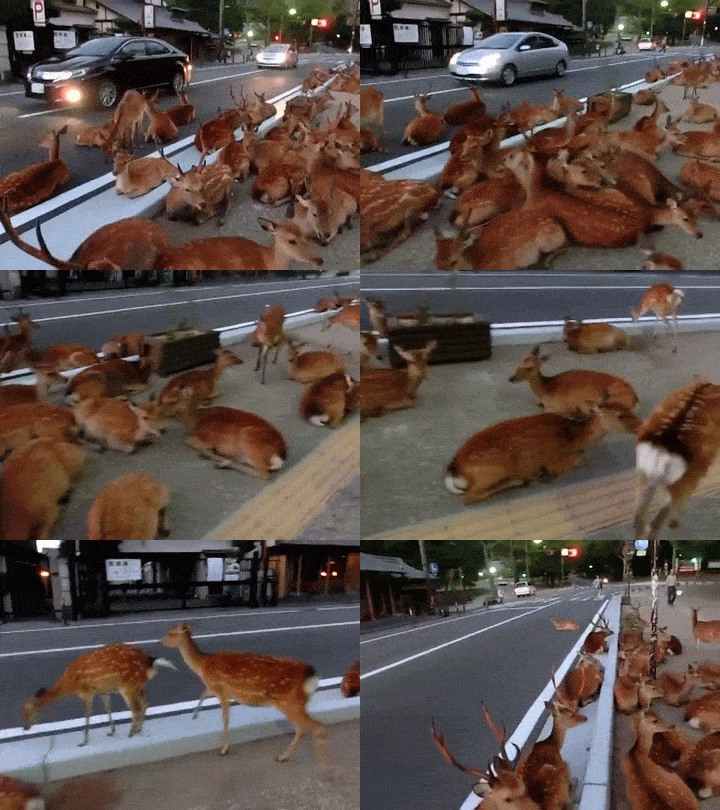
My husband and I have made a few trips “down island” lately, most recently yesterday afternoon. Driving back up island just after sunset, we settled in for a couple hours of extreme vigilance. See, there are a lot of deer on the island, and that early-evening, waning-light time of day seems to draw them to the roadsides, where they graze on the dry grass and leap out at random to cross the highway.

We may not have quite this many... ;)
My hubby hit a deer a couple years ago, on this same drive (the deer lived, but the car had over $2000 damage and was in the shop for a week), and he and I have both had close calls at other times. So, we’re cautious, doing whatever we can to prevent an incident that, at best, would result in minor damage to the deer and our car, and at worst, would be…well, much worse. We reduce our speed, avoid that hard-to-see time of day when possible, use the high-beam lights, and constantly scan for deer.

This morning I’m thinking about vigilance—not for dangers of the wildlife-encounter sort, but for dangers that can leap from the shadows along our publishing journeys and completely derail our writing. But what dangers are there, and how can we guard against them?

  1. Comparison. Comparison is a joy-killer, a confidence-killer, a creativity-killer, an all-round nasty villain. We have got to remember that we are on our own journey, that someone else's path is not our path. When we're tempted to compare timelines, numbers of rejections, size of advance, sales numbers, or any other "measure", just...don't. And on those days when that stuff keeps landing in front of our face, let's turn comparison on its head, and instead of feeling bitter or jealous or defeated, let's choose the “rising tide lifts all boats” mindset. Another person’s success does not take the place of our own…it may even pave the path and open the door. Those celebrity deals and blockbuster sales? They allow the publisher to afford to offer deals to debut authors, to take a financial risk on unknown writers. And those I’m-happy-for-her-but-she’s-got-what-I-want situations when another writer finds success? Let them motivate us to improve our craft or finish our work, and let them remind us that it is possible, that good things do happen to struggling writers. And then cheer and be thankful to witness their success, letting it buoy us up along the way.
  2. Ill-conceived goals. It's always discouraging when we fail to achieve a goal, but when our goals are "ill conceived" in the first place, we're really putting ourselves in harm's way, setting ourselves up for a major crash. Ill-conceived goals are ones that are based on things largely out of our control. We cling to them, but we may be confusing goals with dreams. We can dream of a six-figure deal, or signing with a great agent, or winning an award, but beyond writing the very best book we can and sending it out into the world, this stuff of dreams is mostly out of our hands; but the writing, the revising, the seeking feedback and improving our craft, the sending it out, and sending it out again…that’s in our control. So let's base our goals on those things: finish a draft by x date, write x number of words per day or week, research and query half-a-dozen agents on our next day off from the day-job, brainstorm ten new story ideas, participate in NaNoWriMo this year, finish and polish our WIP in time for the next Pitch Wars, save enough money to attend a nearby conference. These goals may not sound as fabulous as the dreams, but we can only hope to someday reach those dreams if we put in the hard work to achieve those building-block goals.
  3. Negative self-talk. We often tell ourselves things we would never dream of telling a friend or critique partner: your writing will never be good enough; you’ll never get a book deal; you may as well give up now. And even after we’re published, imposter syndrome has us continuing to send such messages: you’re a fraud; your success is a fluke; you’ll never be able to write another book. Those messages can sap our creative energy in no time. I’m not suggesting we should be cocky writer-brats, but we do need to believe in ourselves and in the value of our work. If our story matters to us, it will matter to someone else. Somebody out there needs the stories only we can tell. So tell them. Tell them the very best way we know how, in the way that is uniquely ours, and send them out into the world. The world needs what we have to offer.
  4. Looking backward. All writers—even those “overnight bestsellers”—have been rejected, disappointed, discouraged. We’re allowed to feel those things. They’re hard, and they hurt. But when we dwell on them, wallowing for far too long, we’re robbing ourselves of joy and stomping on our creative spirit. Who can write when we feel that lousy? I say, limit that shit. Allow ourselves to feel the sting for an hour, or a day if we must, but then move on. Learn what we can from the experience, then leave it behind.  Onward!

There are other dangers--distraction, procrastination, being closed to learning, and other things that can derail our writing--but this post is long enough already! I'd love to hear your perspective and any tips you have to share. Tell me, in your experience, what is most likely to derail your writing? What helps you avoid that danger?