Showing posts with label Historical Fiction. Show all posts

Monday, October 19, 2015

Interview With Author Of HIDDEN HISTORIES: FREEDOM'S PRICE


Eliza Scott isn’t quite a slave, but she’s not free either. She’s not a prisoner, but her family lives in a jail. Eliza, who attends a secret floating school on the Mississippi River because it’s illegal for her to read, says she understands how dangerous her situation is—but her parents know she’s not afraid enough. When a devastating cholera epidemic strikes the city, Eliza discovers she will have to be clever and resourceful to escape a slave catcher and the worst fire in St. Louis’ history. Will Eliza be willing to pay the price of freedom? Freedom’s Price is the second book in the Hidden Histories series, which examines little known moments in American history.


 Your series sounds awesome! Tell us a little more: If you were pitching it to a MG reader, how would you describe it?

Hidden Histories is like lifting a rock off some of the dirty incidents in America’s past and taking a peek. Some unbelievably awful things have happened in our history and are not well-known. I take those incidents and weave a story from a kid’s perspective. The important thing is that I try to present all the points of view fairly.  Things that happened in the past can be incomprehensible to a modern reader – I try to show some context. In Freedom’s Price – I show all the different ways a black girl could exist in St. Louis – she could be free, a fugitive, a true slave or like my main character somewhere in between.


Wow. You totally hooked me! Tell me about what you like to read? What are a few of your recent favorite Middle Grade reads?

I really liked Like a River: A Civil War Novel by Kathy Reichman (Calkins Creek 2015) and Dash by Kirby Larson (Scholastic 2014).  They are both very different but they superbly do their job of enticing younger readers into history.


Tell us a bit about why you started writing Middle Grade and what your road to publication was like?

I originally started writing young adult. My books with Chronicle have all featured famous women as teenagers: Queen Victoria (Prisoners in the Palace, 2010) and Beryl Markham the aviatrix who grew up in Africa (Promise the Night, 2011). Then I started a literary mystery series using the same conceit a teenaged Emily Dickinson solving a murder based on a poem (Nobody’s Secret, 2012), the Bronte sisters investigating a mystery on the moors (Always Emily, 2013) and most recently Louisa May Alcott solving a murder that threatens her own family (The Revelation of Louisa May, 2015).

My middle grade writing started when I was introduced to Carolyn Yoder, my editor at Calkins Creek, an imprint of Boyds Mill Press. She was interested in historical fiction about America’s past but touching on themes that hadn’t already been written about.  Our first story was Rory’s Promise (Calkins Creek 2014) which is about orphan trains and is based on a true story in Arizona. And now Freedom’s Promise about Eliza Scott.


What are you writing rituals? Do you listen to music? Where do you write? Anything you must eat or drink? How long does it take you to write a first draft?

I love listening to music. I usually go for Baroque channels on Pandora.  I drink a lot of coffee. When I really need to get stuff done, I light one of my favorite candles (the best one smells like, and I do not lie, Heirloom Tomatoes).  I have an office at home, but in fine weather I like working on my deck.  

I’ve taken four years to write a draft (my first and still unpublished manuscript). But now I have deadlines and a series to write. So I usually spend a month or two researching and thinking – then write a draft in 3 – 6 months after that.


What was it like writing a sequel? Scary? Fun? What are you most excited about with this new book?

Actually Freedom’s Price isn’t a sequel. It is a different story altogether from Rory’s Promise.  This series is meant to explore different time periods in American history.  Rory’s Promise was about an Irish orphan ending up in a remote mining town in Arizona. She travels there with the Sisters of Charity of NYC.  Rory as a character felt familiar and easy to write (I went to Catholic school). But Freedom’s Price is about a young black girl. That was an enormous challenge and so important to get it right. It was scary but I think it came out OK!


What advice would you most like to pass along to other writers?

There is a huge difference between writing as a hobby and writing as a profession.  The further into the job you get, ironically you spend less time writing. You have to do marketing and social media. You have to take days to do school visits and book festivals.  If you’re lucky, your publisher brings you to conferences like NCTE and TLA.  But write we must – so we find the time. 


 Check the HIDDEN HISTORIES series, available now: http://www.amazon.com/Freedoms-Hidden-Histories-Michaela-MacColl-ebook/dp/B015JWL47G/ref=sr_1_2?s=books&ie=UTF8&qid=1445211064&sr=1-2

From School Library Journal

Gr 5–8—History comes alive in this imagining of the life of Eliza Scott, one of the daughters of Dred Scott, the slave at the center of a landmark case in American history. This novel begins after the Scott family has sued their owners for their freedom and they're waiting to hear a VERDICT. The Scotts are forced to live in the St. Louis, MO, jail, and all of the wages they earn are held in escrow by the sheriff. Not much is known about the real-life Eliza, but these authors' depict her as brave, headstrong, and intelligent. She attends a secret school for black children where she has learned to read, and she longs for a different life than that of her parents. But it is her fear of being imprisoned that ultimately puts her freedom in jeopardy. Against her mother's wishes, Eliza takes a job with one of her father's former owners, Charlotte Charless. In the midst of the chaos and fear caused by a cholera outbreak, Eliza crosses paths with the greedy son of Charlotte, Mark Charless, who is desperate for money to fund his Gold Rush dreams. As her family is fighting for their freedom, Eliza's own struggle takes a more dramatic and immediate turn. Not shying away from some of the ugly truths from this part of our country's history, this book addresses slavery, kidnapping, and the overall appalling treatment of black people. While the characterization is well done, the dialogue is a bit stiff. Ultimately, however, this book is a compelling and exciting narrative as well as a window into a possible history. VERDICT A great choice to support school curriculum.—Heather M. Campbell, formerly at Philip S. Miller Library, Castle Rock, CO


Friday, September 4, 2015

Interview with Gayle Rosengren, Author of Cold War On Maplewood Street


Last year I read and reviewed What The Moon Said, a really cool MG historical set during the depression. Well, Gayle is back with another historical MG novel that I'm super excited about!  Check out this the book and our interview with this up and coming MG author, Gayle Rosengren!


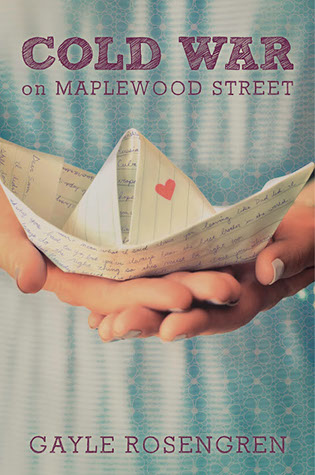
Cold War on Mapplewood Street

It's been a few months since her adored brother Sam joined the navy, but Joanna still misses him desperately.  Sam broke his promise that he wouldn't leave her, like their father did, so she can't help feeling hurt and betrayed and she refuses to answer his letters. But then President Kennedy appears on TV to announce that the Russians are bringing nuclear weapons to Cuba. That's a direct threat to the United States! He insists that the Russians remove the weapons at once, and he sends ships to the area to stop Russian ships from bringing more weapons in.  What if Sam's ship is one of them?
Joanna is frightened, and she's not the only one.  Parents, teachers, newscasters and people in countries around the world are scared, too.   How Joanna learns to live with hope in the face of fear is at the heart of this story about what it means to grow up in a world full of uncertainty, both then and now.

Find it on Amazon and Goodreads


Why did you choose to write historical MG?
It's not so much that I chose to write historical fiction; it just happens that these were the first two stories I felt compelled to write.  What the Moon Said was inspired by some events in my mother's childhood and Cold War on Maplewood Street stemmed from a major event in mine.  The story I'm currently working on is contemporary, and it's likely that will be the case for most of the stories that follow it.  I'm not committed to time periods, only to the stories I feel are important to tell.

What is your favorite thing about writing Middle Grade?

My favorite thing is knowing how much young readers take books to heart-- knowing that if they love my book today, they will probably still remember it fondly many years from now.  Middle grade books can make an impact that is uniquely personal because they're  the first books youngsters read on their own. They are also the books that usually start children down the road to being life-long readers, and that's something very special to be a part of.


What was your inspiration for writing?

When I was a girl, my family had very little money, which meant opportunities for entertainment were severely limited.  But thanks to libraries I always had books. They became an enormous part of my world.  I lost myself in them for hours every day.  Through reading I was whisked away to different places and different times and I made countless book character "friends." I liked some of them so much that it could be difficult to read the last page, knowing my time with them was coming to an end.  (Thank goodness I could flip back to the beginning and start all over again if I wanted to, and I often did!)  It was reading these books that fired my dream of someday writing books that would  mean as much to future young readers.  

What scene was really hard for you to write and why, and is that the one of which you are most proud? Or is there another scene you particularly love?

The most challenging scene to write was the dinner scene with the Watermans.  There were a lot of characters interacting around the table, and there were several undercurrents that I wanted to establish. But since everything was being seen through Joanna's eyes I had to be careful not to make her too "knowing."  She had to see things without necessarily understanding all of what she was seeing--like the angry expression on uncle Zack's face, and Mrs. Waterman's tears as she flings her slice of cake into the garbage. 
My favorite scene to write, though, was the one where Joanna turns her closet into a bomb shelter.  It was fun deciding what she'd put in it. It was also a transformative scene  that shows Joanna finally taking action, on her own, to feel safer.

What do you hope readers will take away from your book?

I hope they will see the importance of speaking up, communicating their feelings, especially when they're afraid or worried--just as Joanna eventually confides in her teacher and her mom and Sam.  Sharing our worries nearly always helps us to feel better..

What's your writing ritual like? Do you listen to music? Work at home or at a coffee shop or the library, etc?

I like to write on my laptop at my desk off the kitchen, with the coffee pot just a few steps away, my dog Fiona dozing at my feet, and my husband Don working at his own laptop nearby.  It's the coziest writing situation ever--quiet, and full of love and positive energy.

What advice would you most like to pass along to other writers?

If writing is your dream, you must go for it with everything in you and never give up.  It took me a long time to be published.  I joke that I'm the poster child for perseverance. But that's what it takes.  Only a few people find success quickly.  For the rest of us it's a bit of an endurance test.  My best advice is to join a critique group of four or five other writers so you can help support each other and improve each other's writing.  Having a good critique group is probably the single most valuable part of a successful writing journey.  I know I couldn't have hung in there without mine.

What are you working on now?

I recently completed a contemporary novel about loyalty that has elements of mystery and suspense. It's Middle Grade, of course!


I can't wait to get my hands on this book! 

 About the author!

 
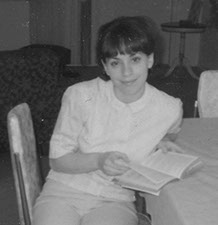
Gayle at age 16

Gayle grew up in Chicago.  Like her main characters, Esther and Joanna, she enjoyed school, was an avid reader, and loved dogs and horses.  She majored in creative writing and philosophy in college and was the editor of the literary magazine


Gayle never outgrew her passion for children's books, though, and she worked in the  children's and young adult departments of a public library in Illinois for several years, enthusiastically sharing her love of books with young people while raising three young readers of her own.


Gayle eventually moved to Wisconsin, where she worked first in the reference library, and later as a copyeditor, at The Pleasant Company, where the American Girl books were published.  During this time she published short stories for children in Cricket, Ladybug, Jack and Jill and Children's Digest magazines.