Showing posts with label craft. Show all posts

Friday, November 20, 2020

How to Become an Author

Many people love to write. Many dream of becoming authors of some sort. Once you've taken up that dream yourself, and particularly if you've been published, you will find more and more people who confide in you - secretly or openly - their burning desire to write a book.

Most don't do more than dream of it. Most don't think to ask the hard questions or put in the long hours to chase after their dream. But if you've clicked on this post, you're different. You're one of those who is ready to embark on the challenging and rewarding path of a writer.

Recently I was interviewed by a student working on his senior paper. It was part of a larger project designed to help students map out their plans for the future. He wasn't really sure what he wanted to do with his life, maybe join the family trade of auto mechanicing. The one thing he was certain about was that he wanted to write. Preferably novels. He wanted to know the path I had taken and what suggestions I might have for him.

Later I realized this would be great info for the readers of this blog. Here's a recap of the highlights of what we discussed.

Education 

While a formal creative writing education at a university or an MFA (masters in fiction writing) program can be useful, neither are essential to becoming a successful writer. A different degree that offers other ways to support yourself and contribute to society can be just as meaningful, sometimes more. My degrees in Psychology and Health Education provide me with work opportunities as well as background knowledge that is useful in stories. 

Most best-selling writers that I know also have a regular career, as a lawyer, a pharmacist, or a teacher, or a coach. Keeping your toes in two different worlds will enrich your writing and help support you financially. Having said that, learning about writing and all the trappings of a writing career is vital to your success.

Conferences and Workshops

One of the best ways to learn about enhancing your writing skills is through attending conferences and workshops. You will find classes at just about every skill level and opportunities to have your work critiqued. Classes typically focus on craft, marketing, platform, editing, publishing, and even inspiration.

Conferences were one of the first places I received objective positive feedback that confirmed I was making progress toward my goal of becoming an author. There are often contests available with financial rewards and sometimes even the possibility of feedback about your writing, which is even more valuable. For more info, check out this Writing Conference Directory.

Inspiration 

People often ask me what inspired me to become a writer.  While each person's motivation and inspiration for choosing to write will be unique, there is a commonality between all writers I've known. It's the burning desire to write. I've loved writing since I was very young. 

But my life took me other places for many years. It wasn't until I was pregnant with my 5th child that I realized I needed an outlet for myself that was completely separate from my identities associated with family and other work. 

So I began writing again. The more I wrote, the more I wanted to write.

The reason I bring this is up is that it is never too early and never too late to begin the journey of a writer. For most writers, the passion for writing is what gets us started. It's a way to process life, filter our thoughts, manage our emotions, and maybe even escape the tedium (or horrors?) or every day life. The passion for writing may start us along the path, but commitment and consistency is what keeps us moving toward our goals. 

As W. Somerset Maugham has said, "I write only when inspiration strikes. Fortunately it strikes every morning at nine o'clock sharp."

There is a saying in writing circles: Butt in the chair. In other words, sit down and start writing, for goodness sakes. Inspiration may strike in between writing sessions. That's what notebooks are for. Otherwise, it's very useful to have a regular writing time and stick to it, even if it's only an hour at 5 in the morning. 

Craft

One of the best ways to hone your craft is to read. Read, read, and read. Not just in your genre, either. You will learn more about writing and plotting as you study novels from a wide array of authors and genres. 

You can also learn specific on craft through studying books about writing. Here's some great ones: The Writers JourneyHooked, and The Red Sneaker Writers Book Series.

There are also about a million different websites with advice on improving your writing skills. Here's a few of my favorites: Writer's Digest, Absolute Write, and Advanced Fiction Writing.

The very best way to improve your craft is (drumroll please....) to WRITE. The more you write, the more you will improve, in sentence structure, imagery, characterization, plotting and more. Look at it as spending your 10,000 hours to become an expert. And who wouldn't want to spend 10,000 hours writing, right? Well, maybe somebody. But to a writer, that sounds like a dream come true. 

Revision and Rejection

Okay, this is possibly one of the tough bumps along the road to becoming an author. You need to find people who will read and honestly critique your work. Preferably people who don't love you and feel an obligation to tell you how wonderful you are. How to find these people? We'll get to that in a minute.

But once you've found them, you need a really tough skin. You need to be able to take criticism and keep working. My husband told me, after about my millionth short story rejection, that I was a glutton for punishment. The thing is, you need to be persistent to reach any valuable goal. You also need to get your work out there and be prepared to be told it needs improvement. Be prepared to be rejected.

Resources for coping with rejection: NY Book Editors, Bulletproof Writer, and this rejection-relief map.

Networking 

One of the best ways to network with other writers is to join a writing group. Check your community  for a group. If you're unable to find anything local, here's a list of writing groups by state or region. 

You can also connect with other writers at conferences and workshops. Both are useful places to form your own group with likeminded writers. It's useful to have a range of interests and genres represented in your writing group as well as a range of skills. 

Your writing group can serve as a source of inspiration and also potential critique partners. You will also find you can refer each other to useful events and websites as well as get the word out about each other's work.

Platform

A writer's platform is their public persona. It includes their online presence on social media, a blog or website, and their contributions to other websites. It can also include classes they teach and speaking engagements. It is basically a springboard for extending the reach of the books and stories they write and engaging with readers.

If you do not have a blog or website, consider starting one now. Considering creating social media pages dedicated to your work as an author. Bring readers along with you on your writers journey.

Publishing

Finally, the fulfillment of your writing dream - publication. Actually, this is just another beginning. You'll now be doing marketing and discovering that you want to publish yet more stories or books. But who wants fulfilled dreams, right? Isn't the chasing of the dream the whole point?

But, I get ahead of myself. There are two basic ways to publish a novel, self-publishing and traditional publishing. Did I say two? Well, there's hybrid now, too. Where a traditional publisher handles the print books and you retain control over digital publishing. 

With self-publishing, you direct everything, from the writing of the book to the editing, title and cover creation, and the actual publication in print and digital form, usually through an online resource such as amazon. Since you manage it all, the royalty payments are much higher than with traditional publishing. However, your ability to market and distribute your book may not compare to that of a traditional publisher. 

To gain access to the big traditional publishers, you will need an agent. Smaller, regional or niche publishers can be approached directly. Your costs will be lower if you go with traditional publishers, but you will also have less control over your final product and will receive much lower percentages for your royalty payments. However, this can all be offset by the marketing expertise of the publishers and the increased sales. It's up to you to decide.


What have been some of your biggest hurdles for writing and some of your most rewarding experiences?

Friday, March 1, 2019

How to Make Scary Stories Come Alive

“Scary, Mommy, it’s scary.” 
“Ok, honey, just a minute. Go back upstairs.”

Not exactly one of my parenting triumphs. At this point, Jessie’s pretty young, my hubby’s out of town, and I’m on an urgent family conference call. She’s seen Jurassic Park before and enjoyed being “scared.” She’ll be fine watching the sequel upstairs with her siblings. Right? Wrong.


I’d forgotten the dreaded picnic scene. You remember the one, where a little girl wanders away from her family and is mauled by tiny dinosaurs? That was too much for my little girl. But it was an excellent scary scene.

How to Write Scary

There’s lots to know when writing scary scenes, such as what type of scene you’re shooting for, how to write it for maximum effect, who your audience is, and why you’re writing something scary in the first place. 

Know the Types of Scary Scenes

Suspense: These are scenes that provoke a sense of anxious uncertainty. Readers feel brought to the edge of their seats. These are great cliffhanger scenes that keep your audience reading. Another example of a suspense scene is when the reader knows something the character doesn’t (that there’s a monster in the closet, for instance).
Spooky: Spooky scenes can include humor or poke lighthearted fun at fear. Think Casper the Friendly Ghost, Ghostbusters, or Goosebumps movies and books.
Terror: Terror scenes provoke intense fear in the reader. These may keep readers looking over the shoulder or jumping at odd noises.
Horror: Very similar to terror, these provoke an intense feeling of fear, shock, or disgust. Horror scenes may or may not include gore.
Fantasy/Paranormal/SciFi: These are any type of scary scene with supernatural or futuristic elements
Psychological: Of course, there is an element of psychology to every scary scene. But in this case, psychology is the main factor. Examples: when the fear is all in the characters’ head, split personalities, social anxiety.

Consider Your Audience

Genre standards and audience preferences should influence how you write your scary scenes, how much gore to include, how light or heavy-handed to be with the frightening elements. In middle grade fiction, story elements can be frightening and suspenseful, but are usually not graphic. Ease your readers into frightening scenes by first having scary things rumored or happening to friends of the main characters. If you write too graphically or intensely for a younger audience, they may be too frightened to finish the book. Gatekeepers such as parents, teachers, and librarians will likely screen the book out.

Make Them Care

Scary scenes are ineffective if the reader doesn’t care what happens to your character. Create relatable characters. Show them being kind. Show their flaws. Show what matters to them, and why. Show their dreams and aspirations. Then threaten all that. Your readers will shudder.

Use Concrete Details to Make it Real

Concrete details ground readers so you can tap their emotions. Suzanne Collins does an excellent job of this in Mockingjay, the third of the Hunger Games trilogy, which is obviously YA, not MG, but still. An amazing example.

I’m referring to the scene of the girl in the yellow coat. 

Katniss is trying to blend into the crowd. A girl notices her. The reader absorbs the image of a little girl in a lemon yellow coat. Sweet. But possibly a threat, since she’s noticed Katniss. But a little girl. A lemon yellow coat. Sweet. But danger. Hmm…reader is feeling anxious.

Gunfire rips through the crowd. Katniss next sees the little girl, screaming beside a motionless woman. We are riveted, gut-punched, and feel the girl’s pain. Then bullets mow her down, too. 

These concrete details make the scene come alive on an emotional level and heighten the reader’s horror at the situation overall, as well as our fear for Katniss, in particular.

Use Setting to Heighten Emotion

Use setting elements to highlight the frightening aspects of your scene. Even a sunny courtyard can have shadows, strangling vines, and blood-red flowers. Better yet, use aspects of the scene to remind the character (and your reader) of what’s at stake. Do forget-me-not blossoms remind her of her brother's eyes? What about when the flowers are trampled and dying?

Examine the Purposes of Your Scary Scenes

Are you trying to force your character to their breaking point? If so, why? Are you showing the character develop a new strength or skill? Will this fearful situation break your character or will they triumph? Will they stick to their values or violate them? What are the mental and physical consequences of how they react?

Scary Writing Resources


Back to Jessie and Jurassic Park. I’m happy to say she suffered no permanent damage for her early exposure to something scary sans Mom. She’s an avid reader and doesn’t shy away from horror films or life’s adventures.

What are your fave scary writing tips or MG horror novels?


Monday, July 9, 2018

3, 2, 1, ACTION!


One of the harder things to do as a writer is to craft an action scene. It not only has to have tension, but it has to make sense to readers so they can visualize it in their head. Writing an action scene can often feel as complicated as choreographing the perfect dance.

As a writer, where do you even begin when it comes to action? How to you make the scene work for you and the story rather than making it feel like work?

Below is a list of things to consider when crafting action scenes.
  1. How long is the action? This seems trivial, but in all seriousness, the average person doesn’t have the stamina to fight or run for more than a couple minutes at a time without outside factors. If this is intended for the long haul, there’s going to have to be hiding and breaks or your characters just aren’t going to be able to keep up. On the other hand, if this is a quick brawl or chase scene then going all out might not be a big deal to your characters.
  2. What's the goal? To run? to win? to kill? to injure? something else? Think about the motivations of the characters. Why are they actually fighting or running? Let this drive how each character acts within the action. Most people don’t want to fight if they don’t have to, so if there’s an alternative look for it. If not, let there be a good reason things are progressing as they are.
  3. Increase the stakes and danger as you go. An action scene shouldn’t just fizzle out. Like the climax of a book, once you hit the peak things move quickly and so should an action sequence. Pacing in general should be quick, but again if this is a long drawn out series of events, then find the natural pause and use them to continue to increase the stakes and danger even if your characters are taking a much needed break.
  4. What are your character's strengths and weaknesses? Play to their strengths sometimes, but also amp up the tension by throwing some curveballs at them. This will not only increase the stakes, but also make the reader more invested in the action.
  5. Similarly, what are your antagonist’s strengths and weaknesses? If your main character knows this, they can use to their advantage. On the flip side, it can be used as motivation for how the antagonist approaches an action or fight scene.
  6. Make your surroundings compliment your mood or contrast. Don’t forget about your surroundings. Pulling in some of the world around the action can further add to the tension and set the tone for an action scene. Don’t be afraid to play with the setting during an action scene, just don’t take too much time to describe the floral bouquet on the counter unless someone is going to hit someone else over the head with it.
  7. Consider sentence length. Shorter sentences can often make things appear like they are happening faster. Brief periods where sentences get shorter can be another way to increase pacing and tension during an action scene. But be cautious, you don’t want to maintain one sentence length for pages on end otherwise the story sounds monotone
  8. Verb choice can also help with pacing. Did your main character turn and run or did they bolt, scamper or stumble away. Each one of those verbs has a very different intention and sets a different tone. Choose your verbs wisely to maximize the impact of the action.
  9. When in doubt, act it out. Or draw it, or animate it whatever you need to do to make it make sense. Don’t be afraid to role play, do motions or enlist some others to help you choreograph the action. Seeing the scene play out in front of you can not only help you make sense of the action but also write it more clearly for the reader to see.
  10. Don’t forget about the reactions. Every action has an equal and opposite reaction. And every action scene should have a series of reactions that come after. Those feelings and reactions are just as important if not more so than what happened during the action. The aftermath reactions are what make the action all worthwhile.

Writing action scenes can be complex, but they can also really move your story along, set the tone, increase the stakes, and help propel your characters forward. What are you favorite tips and tricks when writing action scenes?

Friday, June 30, 2017

Breathing Room: Or, what the ocean taught me about pacing

If you’ve been hanging around me or my social media sites much at all, you know I love the ocean. One of the things I love about it is how it always changes. Last week on one of my beach-walks, the ocean was quiet. No wind, so no waves – no crashing over the rocks, barely even any noticeable gentle-breaking against the shore. The gulls were strangely quiet, too. Perhaps they’d already had a good feed and were snoozing somewhere while their breakfast digested. In all that absence of noise, the sound I became aware of was the scritch scritch of crabs scurrying about under the rocks.


This was a very different experience than the beach on a stormy day – wind howling past my ears, surf pounding relentlessly against the rocks. The ocean on a stormy day is all about power, and not so much about subtle scritch scritching.


It’s not just the water that changes, of course. Every day the driftwood has been rearranged and new flotsam and jetsam has been offered up. There’s always some new shell or stone or piece of sea glass to catch my eye. And have you noticed how different the air smells at low tide than at high tide? All these things – the changing sights, sounds, smells – keep the beach interesting and make me want to go back again and again (and I do!).


Recently I was thinking about pacing in fiction. And just as a walk by the ocean every single day might get dull if things never changed, if it was predictable, if there was never anything new to grab my attention, so it is with fiction. If scene after scene is the same pace, I’m likely to put the book down. If it's all fast, I get tired; if it's all slow, I get bored. But if it changes, if it has both quiet moments that allow me to discover hidden treasures, and dramatic moments that take my breath away by their power or action or suspense, then I keep reading.

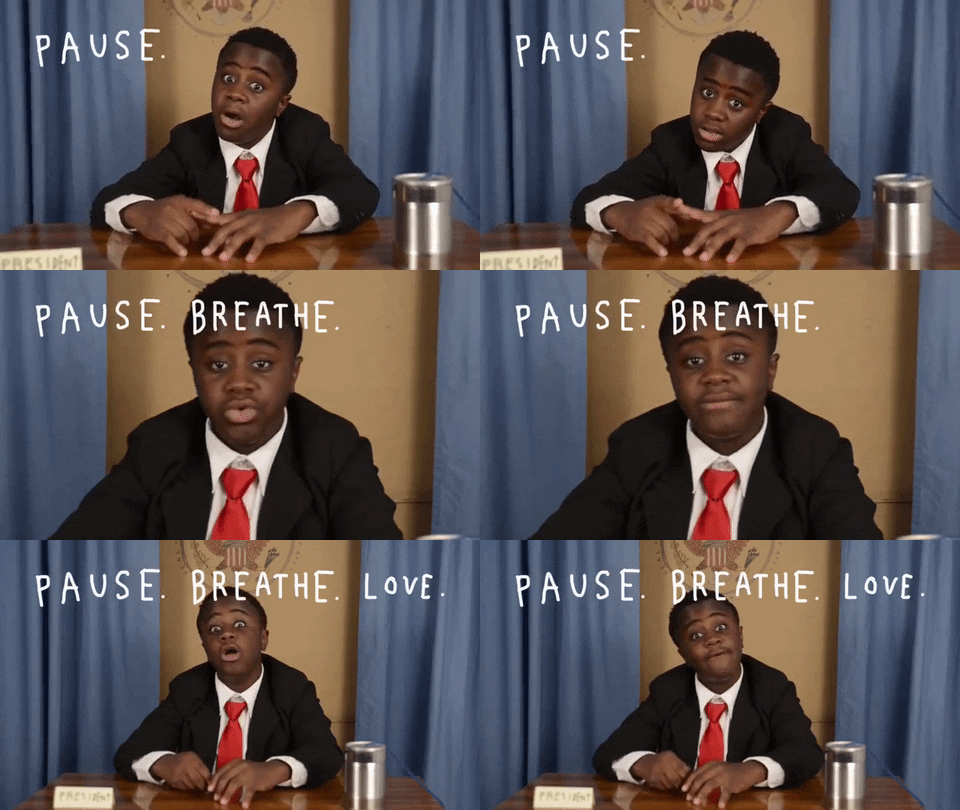
The variety in pacing comes naturally if you use an “action/reaction” or “scene/sequel” structure when you’re writing and revising. If you’re not quite so intentional while you’re first-drafting (like me), just think of pacing as giving readers time to breathe after those scenes that make them hold their breath.


Great pacing = giving readers time to breathe
after making them hold their breath.


Those slower scenes shouldn’t put your readers to sleep, however. You’ve likely heard the advice to “leave out the boring parts”. Think about it – which parts do you skip when you’re reading? Probably excess backstory, or some “set-up” or exposition that somehow missed getting cut during revisions. If it’s not essential, leave it out.

So what can go in the slower scenes? Each scene still has to move things forward plot-wise or character-development-wise, but the quieter scenes likely contain things such as:
  • a character reacting to what just happened
  • the aftermath of an action
  • description or essential backstory
  • introduction or continuation of a sub-plot. 
And of course, the pace can be slowed by word choice and sentence structure. So, conflict and tension, yes – you want the reader to keep turning pages – but vary it. Think breathing room.


If the ocean never changed…well, truth be told, I’d probably keep going to the beach, lol. I just love it that much. But if the pacing in a story never changes – whether it’s constantly fast, or constantly slow – I’m probably going to close the book. Want to keep me reading? Make me hold my breath, then give me time to breathe.