I have a slight problem with the manuscript I’m working on.
It isn’t related to plot; I feel like I’ve got the mental outline pretty much put together, leaving enough room for the story to continue evolving as I write. It isn’t really about character, either; even though this story has a lot of characters, I have a decent grasp on who each of them are, who they’ll become by the end, and how they relate to each other. The problem definitely isn’t about voice; that’s coming through well so far, maybe because I’m allowing myself to write with a voice I’ve wanted to use for a long time, but haven’t found the right project for until now.
My problem is I still haven’t put together a writing playlist.
Now, do I need a writing playlist for this? Thankfully, no. The story is coming along surprisingly well. Would I like to have a playlist providing the soundtrack for this journey? Most certainly yes. Finding the right music has always been an important part of the writing process for me. I wrote my first manuscript while listening to nothing but the same thirty Bruce Hornsby songs on shuffle, usually during the time of day when light from the sunset poured in the front windows and filled my house, just because all of that gave me something close to a tangible expression of the tone I was trying to create. I wrote another manuscript mostly after dark with all the lights off, listening the scariest Iron Maiden songs I could find, as well as a few others that matched up with that creep factor. One year during NaNoWriMo I had a playlist of over two hundred songs that dripped emotional catharsis, to help me get in the head of a character pulled in nine different directions by everything she was struggling to understand. I’ll use these songs and the feelings they inspire to guide my voice, and, if I’m being honest about it, to help visualize what it might be like if, say, my story ever became a movie and needed a soundtrack. After all, isn’t a good part of the writing somehow tied to trying to live out hopes and dreams and speculation?
Truthfully though, I’ve never needed much of a reason to assemble playlists. I’ll put them together for road trips, or school work days when the students aren’t around, or to have playing in the background when I have guests, or even just because it feels like a day to listen to nothing but music released between 1997 and 2004. Applying this hobby (habit?) to my writing seemed natural.
Back before I found my way to the online writing community, I thought it was mildly self-indulgent to be so insistent about finding the perfect music to pair up with whatever I was writing. Then I started connecting with other writers, and discovered many had similar habits. A lot crafted playlists just as I did, but others didn’t stop there: They made Pinterest boards based on what their characters looked like. They compared different aspects of their characters to other well-known characters from books and movies and TV shows. Some even tried matching up settings with appropriately scented candles. They had favorite locations to write, rituals and routines they followed, and reward systems to keep themselves motivated. It seemed that nearly everyone populating this magical online writing domain was, in one way or another, searching for and leaning on the same kind of creative self-support I had been using all along.
That discovery made my propensity for playlists seem, if anything, less like an idiosyncrasy and more like a legitimate part of the writing process, at least for me. That circles back to the simple truth that everyone approaches their writing differently, and whatever process works for each individual is just as legitimate as anything else.
Of course, this still leaves me working without a playlist for this new project, or even any first steps in the direction toward finding one. I still have a long way to go though, so I know the right songs will eventually present themselves.
I’m just really looking forward to finding out what they’ll be.

Monday, June 12, 2017

Friday, June 9, 2017
3 Essential Strategies for Writing Meaningful Middle Grade Fiction

So you’ve got a great book idea and a plan for making it happen. You know all about hooking the reader early, building your plot, and including character transformation. But still the story tanks. Or maybe your peers love it, but agents aren’t picking it up. Or even worse, beta readers in your target age group don’t even finish the book. And yes, if you’re writing middle grade, you should find a few middle grade readers to give your book a whirl—assuming that’s not a whirl down the toilet. Of course, if that’s where the novel ends up, that’s a pretty clear sign you’ve got some work to do.
As much as we like to weave adventure and meaning into our stories, it only matters if we connect with our intended audience. So how do we do that with middle grade readers? Most of us are years (or decades!) away from that age group, so it can be tough to remember how we thought and what we felt back then. Even if we could, the modern issues and modern voice of that age group has changed to some degree.
Here are three proven ways to connect with your middle grade readers, write fiction that means something to them, and keep them up at night with a flashlight, reading under the covers.
1. Know the Issues
What sorts of challenges do middle grade readers face on a day to day basis? It is vital to recognize and understand these issues in order to write something they can identify with (note that middle grade is not the same as middle school. Instead, it is children ranging from 7-12 years old). These issues can vary widely depending on the age of the child.
Younger middle grade readers are learning how to interact and form social bonds. They are starting to understand and experiment with social power, which, at this age, can lead to intentional meanness. Michelle Anthony, Ph.D. writes on scholastic.com that most children do this at some time or other as they try to exert social power in inappropriate ways. Most children are also on the receiving end at some point as well. This is not the same as targeted, systematic bullying, but it can lead to that without proper intervention and instruction from parents, friends, teachers, and books.
At this age, children want to be seen as intelligent. They often start arguing their viewpoint. They need to feel empowered and able to make choices. They are also learning to recognize and appropriately express their feelings.
According to Jennifer O'Donnell at Verywell.com, some common challenges upper middle grade readers face include depression and anxiety, substance abuse, risky behavior (taking chances with their safety), obesity, low self-esteem, and too much unsupervised free time.
Many issues span all ages of childhood. Some of these include living in a single parent home, coping with divorce, sibling rivalry, educational disparity, abuse, neglect, living in poverty, difficulty relating to peers, and dealing with bullying. Be sure to keep your content at a level appropriate for middle grade readers as you deal with some of these painful issues.
2. Discover your MG Voice
Now that we’re armed with a clear idea of the issues facing middle grade readers, it’s time to witness those issues in action. The best way, of course, is observing them in real life. Be aware of the interactions between children in this age group, whether in your own home, at school, among relatives, at church, a movie theater, the park, or the pool. The possibilities are endless. Just don’t be a creeper and freak anyone out.
If real-life observation is not an option, talk with parents or teachers of middle grade kids. They can offer great insights into the culture and thought processes of children in this age group.
When you read books that target this age group, pay close attention to the attitudes, conflicts, and voice of the characters. Some great places to start: the Percy Jackson books, Wonder, the Septimus Heap series, Diary of a Wimpy Kid, and, of course, Harry Potter.
Do the same thing when you watch middle grade movies. Great movies that give insight into the voice and issues of MG readers: Bridge to Terabithia, Pete’s Dragon, The BFG, The Chronicles of Narnia, and Anne of Green Gables.
As you research, experiment with your writing. Try out different voices and attitudes. Although middle grade readers may share some of the same developmental and social challenges, they are unique individuals with distinct ways of viewing themselves and the world. Practice capturing a different voice for each of your middle grade characters, revealing their unique interests and thought patterns.
A word of caution - be sure not to “talk down” to middle grade readers. Although they are young, they are savvy readers and can spot a false voice in seconds. Their problems are as complex as ours and should be treated with respect, taking care to avoid simplistic answers.
If you struggle with this, just keep at it. Keep studying and practicing. You will end up with better stories that capture your readers’ attention and can make a difference in their lives.
3. Dig Deep
To further enrich your writing, dig deeper into middle graders' voice and their challenges. Here's some useful websites and articles to get you started.
http://www.scholastic.com/parents/resources/article/stages-milestones/emotional-lives-8-10-year-olds
kid lit.com (Mary Kole's book, Writing Irresistible Kidlit, is an indispensable resource!)
What are some of the issues you address in your middle grade writing?
How do you nail middle grade voice?
How do you nail middle grade voice?
Monday, June 5, 2017
14 Hollow Road Author Interview and ARC Giveaway
I’m excited to have author Jenn Bishop with us today. Her newest middle grade, 14 Hollow Road, hits shelves June 13.

The night of the sixth-grade dance is supposed to be perfect for Maddie: she’ll wear her new dress, hit the dance floor with her friends, and her crush, Avery, will ask her to dance. But as the first slow song starts to play, Avery asks someone else to dance, and then the power goes out. Huddled in the gym, Maddie and her friends are stunned to hear that a tornado has ripped through the other side of town, destroying both Maddie’s and Avery’s homes. Kind neighbors open up their home to Maddie and Avery’s families, which both excites and horrifies Maddie. Meanwhile, she must search for her beloved dog, who went missing during the tornado. At the dance, all Maddie wanted was to be more grown-up. Now that she has no choice, is she really ready for it?
Jenn, what inspired you to write 14 Hollow Road?
I’ve been chatting a lot this past week with classes that have used The Distance to Home as a read-aloud and so many of the students have been curious about whether elements of that story are autobiographical--particularly, did I have a sister that died? While that book is entirely the product of my imagination, 14 Hollow Road in many ways hits closer to home. For one, it’s set in a small (fictional), rural Massachusetts town very much like where I grew up, with a regional junior high and high school. When I imagined Maddie and her world, especially the dynamic between her friend group and some of the boys in her class, I was drawing on my own memories of that time. Sixth and seventh grade were pivotal years, but they were also trying times. It’s not just that your body is changing, but that it feels like everything is changing. The way you relate to adults is changing, how you see the opposite sex is changing, and then, oh right, there’s the real world, too, which in Maddie’s case means a very unexpected weather event throwing a wrench in her best laid plans. I never thought I would write a book about a tornado, given that in New England they aren’t exactly common, until the summer of 2011, when a rare EF3 tornado crossed the street on which I grew up, and where my parents still live. While their home was spared, many others were not so fortunate, and the familiar landscape of my childhood now bears the scars of that the twister. I wondered how my own transition into a new school—amid all of the hormonal changes of being a seventh grader—might have been changed by such an event.
The main character, Maddie, feels so real—her first-crush feelings toward Avery, her conflicting emotions when her BFF starts hanging with a new friend, and her utter horror when her monthly period starts on the day of the 6th grade pool party. As a writer, how do you manage to capture the innermost feelings of an almost-seventh grader? Any advice for writers hoping to develop authentic middle grade characters?
I think the key to getting back into that headspace is remembering the feelings of that age in real time. No adult reflections allowed! Now, I am one of those people who has a hard time of letting go of ephemera. I still have boxes in my closet of notes and photos and ticket stubs and all that jazz. Thank goodness! Perusing that stuff brings back so many memories—including cringe-worthy moments I’d like to forget. There are other ways to get back to your middle school self, too, of course. Re-read the books you loved then. Re-watch the movies you VHS-taped off the TV (child of the 1980s and 90s here). Listen to the soundtrack of your childhood. Reading contemporary books that dive into those muddy waters also helps. Two of my favorite middle school books in recent years are Well, That Was Awkward by Rachel Vail and Goodbye Stranger by Rebecca Stead. While the times have changed since our own emerging adolescence, so many of the essential emotional experiences have stayed the same.
This is your second book for middle grade readers. How did writing this novel differ from drafting your debut, The Distance to Home?
I wrote the first draft of The Distance to Home when I was in the MFA program at Vermont College of Fine Arts. In my second semester with Rita Williams-Garcia, I wrote the entire first draft. Well, turns out you can’t just have Rita Williams-Garcia as your regular beta reader (what a dream, right?). 14 Hollow Road was the first book I started after finishing my MFA, which meant that I was the one holding myself accountable. In truth, though, the drafting process was still quite similar. I’m a very linear thinker and a pantser, so I pretty much just banged the draft out over a few months. That said, the revision process was challenging. This is the first thing I’ve written where I pretty much had to re-write the entire thing because I didn’t like how Maddie “sounded” in the first draft. My critique group was also essential—so willing to read various drafts. They provided some great big picture feedback that helped me reframe a lot of the events of the story. While the key scenes in The Distance to Home never changed in huge ways, much of the latter 2/3rds of 14 Hollow Road was drastically reshaped in revision. I guess what they say is true: each book teaches you how to write that book.
Thanks so much, Jenn!
For a chance to win an ARC, leave a comment and your email below. A winner will be drawn at random.

The night of the sixth-grade dance is supposed to be perfect for Maddie: she’ll wear her new dress, hit the dance floor with her friends, and her crush, Avery, will ask her to dance. But as the first slow song starts to play, Avery asks someone else to dance, and then the power goes out. Huddled in the gym, Maddie and her friends are stunned to hear that a tornado has ripped through the other side of town, destroying both Maddie’s and Avery’s homes. Kind neighbors open up their home to Maddie and Avery’s families, which both excites and horrifies Maddie. Meanwhile, she must search for her beloved dog, who went missing during the tornado. At the dance, all Maddie wanted was to be more grown-up. Now that she has no choice, is she really ready for it?
Jenn, what inspired you to write 14 Hollow Road?
I’ve been chatting a lot this past week with classes that have used The Distance to Home as a read-aloud and so many of the students have been curious about whether elements of that story are autobiographical--particularly, did I have a sister that died? While that book is entirely the product of my imagination, 14 Hollow Road in many ways hits closer to home. For one, it’s set in a small (fictional), rural Massachusetts town very much like where I grew up, with a regional junior high and high school. When I imagined Maddie and her world, especially the dynamic between her friend group and some of the boys in her class, I was drawing on my own memories of that time. Sixth and seventh grade were pivotal years, but they were also trying times. It’s not just that your body is changing, but that it feels like everything is changing. The way you relate to adults is changing, how you see the opposite sex is changing, and then, oh right, there’s the real world, too, which in Maddie’s case means a very unexpected weather event throwing a wrench in her best laid plans. I never thought I would write a book about a tornado, given that in New England they aren’t exactly common, until the summer of 2011, when a rare EF3 tornado crossed the street on which I grew up, and where my parents still live. While their home was spared, many others were not so fortunate, and the familiar landscape of my childhood now bears the scars of that the twister. I wondered how my own transition into a new school—amid all of the hormonal changes of being a seventh grader—might have been changed by such an event.
The main character, Maddie, feels so real—her first-crush feelings toward Avery, her conflicting emotions when her BFF starts hanging with a new friend, and her utter horror when her monthly period starts on the day of the 6th grade pool party. As a writer, how do you manage to capture the innermost feelings of an almost-seventh grader? Any advice for writers hoping to develop authentic middle grade characters?
I think the key to getting back into that headspace is remembering the feelings of that age in real time. No adult reflections allowed! Now, I am one of those people who has a hard time of letting go of ephemera. I still have boxes in my closet of notes and photos and ticket stubs and all that jazz. Thank goodness! Perusing that stuff brings back so many memories—including cringe-worthy moments I’d like to forget. There are other ways to get back to your middle school self, too, of course. Re-read the books you loved then. Re-watch the movies you VHS-taped off the TV (child of the 1980s and 90s here). Listen to the soundtrack of your childhood. Reading contemporary books that dive into those muddy waters also helps. Two of my favorite middle school books in recent years are Well, That Was Awkward by Rachel Vail and Goodbye Stranger by Rebecca Stead. While the times have changed since our own emerging adolescence, so many of the essential emotional experiences have stayed the same.
This is your second book for middle grade readers. How did writing this novel differ from drafting your debut, The Distance to Home?
I wrote the first draft of The Distance to Home when I was in the MFA program at Vermont College of Fine Arts. In my second semester with Rita Williams-Garcia, I wrote the entire first draft. Well, turns out you can’t just have Rita Williams-Garcia as your regular beta reader (what a dream, right?). 14 Hollow Road was the first book I started after finishing my MFA, which meant that I was the one holding myself accountable. In truth, though, the drafting process was still quite similar. I’m a very linear thinker and a pantser, so I pretty much just banged the draft out over a few months. That said, the revision process was challenging. This is the first thing I’ve written where I pretty much had to re-write the entire thing because I didn’t like how Maddie “sounded” in the first draft. My critique group was also essential—so willing to read various drafts. They provided some great big picture feedback that helped me reframe a lot of the events of the story. While the key scenes in The Distance to Home never changed in huge ways, much of the latter 2/3rds of 14 Hollow Road was drastically reshaped in revision. I guess what they say is true: each book teaches you how to write that book.
Thanks so much, Jenn!
For a chance to win an ARC, leave a comment and your email below. A winner will be drawn at random.
Monday, May 22, 2017
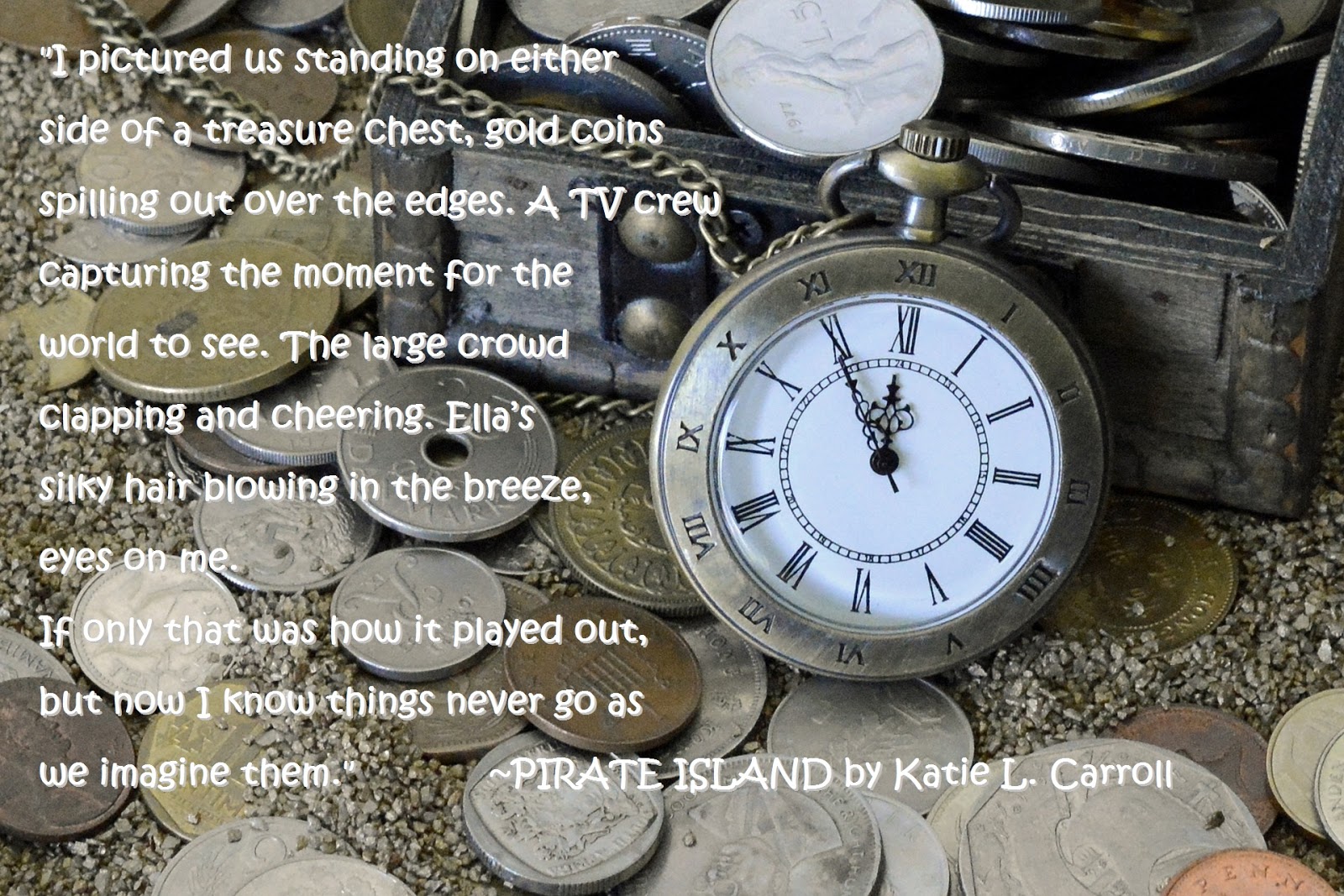
Cover Reveal: Pirate Island and Guest Post by Author Katie L. Carroll
An Inside Look at the Cover Process for the Middle Grade Adventure
PIRATE ISLAND
by Katie L. Carroll
One of the coolest things about being an indie author is
having total control over your cover art. It’s also terrifying! A cover is one
of the most important parts of a book, giving readers their first impression of
the story. Anyone with a basic computer skills can create a cover, but not
everyone can create a good cover…never mind a great cover.
When it was time to figure out what I wanted for the cover
of my middle grade adventure PIRATE ISLAND, I knew I wasn’t going to do it
myself. I am not an artist or designer and felt it would be best to hire a
professional. After browsing through a ton of recent middle grade titles, I
decided that I wanted a piece of original artwork.
But who would I hire to do that? I’m not a publishing house
with a big budget and a pool of talented artists waiting to work with me. So I
stuck with the contacts I have. Illustrator Susan Tait Porcaro (susantaitporcaro.com) had one of my
favorite illustrations in THE GREAT CONNECTICUT CAPER, a collaborative middle
grade mystery created by 24 different authors (I wrote chapter 2) and
illustrators.
I contacted Susan about PIRATE ISLAND, she was interested in
the project, and her rates fit my budget. We set up a timeline, signed a
contract, and Susan got to work. I had to provide her with more information
about the book itself and gave her some of my thoughts about what kind of cover
I had imagined, including details about Billy, the main character; the setting;
and the mood of the book.
Susan got to work on a black-and-white character sketch and
sent it to me to review. There’s nothing quite like seeing a character I created
in my head come to life as an illustration. We discussed changing Billy’s
expression and posture. She sent more sketches that incorporated those changes
and added setting details. The cover concept was becoming a reality.
Then came color! Susan thought a vivid sunset with lots of
orange would make for a striking color scheme, and I was totally on board with
that. Then I got to see a full color illustration of just Billy. Once we
settled on all the little details about him, next came the details for the
setting.
When I got a look at the near final cover image, tt was love
at first sight! I thought Susan had really nailed the mood I was looking for,
and she did it in such a striking way.
The final details included font and color for the title and
author name. Then for the paperback version, I had to provide her with the
proper size and finalized jacket copy. That took a little work on my part
because I had to make sure I knew how many pages the actual book was going to
be. And I had to make sure I had written a compelling teaser for the back of
the book that would encourage readers to pick it up.
I couldn’t be happier with the cover Susan created for
PIRATE ISLAND. The concept of it was a collaborative process between the two of
us, but it took the creativity and vision of a truly skilled illustrator to
take that concept and turn it into a gorgeous book cover that offers an
enticing promise to readers about the story inside.

PIRATE ISLAND blurb:
A thrice cursed island, a legendary pirate treasure, and one not-so-brave boy. What could possibly go wrong?
For centuries, the whereabouts of Captain William Kidd’s
lost pirate treasure has remained a mystery. When Billy’s best friend, Andy,
proposes they look for it on nearby Pirate Island, Billy thinks it’s just
another one of their crazy adventures. It’s usually Billy who ends up in
trouble as a result, but he goes along for the ride…like always. The more he
delves into the life and death of Kidd, the more he thinks the treasure is real
and that it might be buried on the small island in Long Island Sound.
Billy—nope, call him William—becomes obsessed with the captain of the same
first name. He even believes he’s possessed by Kidd’s restless soul. Now he and
the spirit of a long-dead pirate are leading the crazy adventure on Pirate Island.
And what they find is far bigger than the treasure they imagined.
Available October 2017! Add PIRATE ISLAND
on Goodreads.
About the Author:

Katie L. Carroll always says she
began writing at a very sad time her life after her sister Kylene unexpectedly
passed away. The truth is Katie has been writing her whole life, and it was
only after Kylene’s death that she realized she wanted to pursue writing for
kids and teens as a career. Since then writing has taken her to many wonderful
places, real and imagined. She has had many jobs in her lifetime, including
newspaper deliverer, hardware store cashier, physical therapy assistant, and
puzzle magazine editor. She works from her home in Connecticut that is filled
with the love and laughter of her sons and husband.
In addition to PIRATE
ISLAND, Katie is the author of the YA fantasy ELIXIR BOUND.
Find Katie on her website, Twitter @katielcarroll, Facebook, and Goodreads.
Friday, May 19, 2017
A Tough Question: how much are you willing to change for success?

Being published is a dream for so many writers, and each story is important to us. We want this story to be read, we want people to love it. We want to see it on bookshelves. (We wouldn’t be putting ourselves through this agony if we weren’t passionate about getting our book published.)
But… the book is also important to us. The characters have meaning. What happens to them is important! (Most of us wouldn’t be able to go through all the work to write and edit a book if we didn’t LOVE the story and characters.)
So what happens when publishing doesn’t agree with the story you have completed? What if, in order to reach the dream of being publishing you have to change something you don’t want to?
This month, I worked as a mentor for #teenpit, where high school writers submitted some of their writing to be mentored by some awesome writers. During the process, my mentee asked me this super deep question about choosing art or business.
We were discussing a possible shift in perspective of her book and she asked me this:
“No matter what I do, I know that if I took the whole thing [insert suggested book changes here] it'd be a million times more marketable, and I'd have a better chance at being published… And I don't want to deviate from my story just because I want to appease the industry, but at the same time, this is my story, and I want more than anything to see it in the world.”
Oh man. That’s a seriously heavy question!
How much are we willing to change to be published?
It’s a very personal question. For some people the answer may be “EVERYTHING! I’ll do whatever it takes to be published!” for others it may be “Nothing! I won’t change for you!” (In which case, I suggest self-publishing). But for most of us the answer is going to be somewhere in-between.
I don’t have a definite answer for you—only you can answer this question for yourself— but I do have some advice that might help if you’re ever in this predicament.
This was my response to my mentee (with a few tweaks to make it less specific, more universal):
"I went through a long R&R process with Entangled for my first book. We totally re-plotted it. It meant an almost total rewrite. I was okay with the changes because it made the book stronger. But there was one thing my editor suggested that I didn't agree with.
There's a scene at the end of the book that my editor wanted to cut. I took a long time to think about it and decided I wasn't willing to cut it. That scene felt like such an important part of Anna's story and honestly, it fit the new focus of the story (A huge theme was about her lying, this was her big moment of telling the truth. Even facing the truth). I told him I wasn't willing to cut it, and he said we'd make it work (a relief because I was really willing to walk away from the deal for that scene). When he read the final version he said he teared up during that scene.
My suggestion is for you to decide what the heart of this story is for you and stick to it. What don't you want to lose?
For me is was Anna. Is was her journey, her emotions, and her sweet relationship with Jackson (though he used to be Arney. They changed his name!) Everything else in the book could change, but so long as those emotions stayed, I felt confident about it.
What is that thing for you?"
It's a hard line to find sometimes. You will need to change things to be more marketable, that’s just part of publishing and if you want to be successful in traditional publishing, it’s a thing you will have to do. BUT this is your story. Please don’t ever forget that YOU make these choices. And it’s okay to walk away from a situation that you feel uncomfortable with, even if it means walking away from a potential publishing deal.
Finding the line you aren’t willing to cross... that parts up to you. It isn’t always easy but you’ll feel better if you are willing to compromise without losing the heart of your writing and story.
Good luck!

Monday, May 15, 2017
Book Review - 5 Worlds: The Sand Warrior
Graphic novels are great equalizers in middle grade books, since they offer so much for readers of different abilities to appreciate. A lot of reluctant readers will page through them because they think a book with a lot of pictures will automatically be easier. What they don’t consider is that graphic novels can present additional layers of challenge. The stories frequently advance through dialogue instead of narration, and often through the artwork alone. As a result, readers need to make inferences while reading graphic novels, which is easier to do when they’re engaged in the story.
The recently released 5 WORLDS: THE SAND WARRIOR, written by Mark and Alexis Siegel, and illustrated by Xanthe Bouma, Matt Rockefeller, and Boya Sun, is the first book in a new series of graphic novels that will have middle graders carrying copies and sketching the characters on the inside covers of their school notebooks.

The story is set against the backdrop of a growing conflict between worlds and cultures. Each of the three main characters comes from a very different life, with their own unique abilities and problems to overcome: Oona Lee, a Sand Dancer, is struggling to develop her skill while living in the shadow and memory of her older sister, Jessa. The young thief An Tzu is doing what he can to survive living in the city while mysterious forces bring slow and gradual changes to his life. Famous Starball athlete Jax Amboy is worshipped by a galaxy of fans, but has his own secrets to contend with. The three are brought together following a cataclysmic attack, and slowly come to realize how much they need each other as they try to save their world.
After I finished reading the book, I loaned it to one of the reluctant readers in my class. He kept it with him all the time, even hiding it in his lap to read when he didn’t think I'd notice. He finished it in two days. I asked him what he thought when he returned it. He said it reminded him of Guardians of the Galaxy. I figured his comparison had to do with the science fiction setting, but he went beyond that. “Because the characters all have their own problems, and even though they don’t get along all the time, they’re still friends and they have to work together.” I loaned it to one of my stronger readers next. She brought it home and finished it overnight. I had to endure a chorus of complaining from the other students when I said I had to keep the book myself for a few days to finish writing the review.
A lot of young readers are going to be taken in by this epic story and these characters, and will be anxiously waiting to find out what will happen throughout the rest of the series. I know I am!
The recently released 5 WORLDS: THE SAND WARRIOR, written by Mark and Alexis Siegel, and illustrated by Xanthe Bouma, Matt Rockefeller, and Boya Sun, is the first book in a new series of graphic novels that will have middle graders carrying copies and sketching the characters on the inside covers of their school notebooks.

The story is set against the backdrop of a growing conflict between worlds and cultures. Each of the three main characters comes from a very different life, with their own unique abilities and problems to overcome: Oona Lee, a Sand Dancer, is struggling to develop her skill while living in the shadow and memory of her older sister, Jessa. The young thief An Tzu is doing what he can to survive living in the city while mysterious forces bring slow and gradual changes to his life. Famous Starball athlete Jax Amboy is worshipped by a galaxy of fans, but has his own secrets to contend with. The three are brought together following a cataclysmic attack, and slowly come to realize how much they need each other as they try to save their world.
After I finished reading the book, I loaned it to one of the reluctant readers in my class. He kept it with him all the time, even hiding it in his lap to read when he didn’t think I'd notice. He finished it in two days. I asked him what he thought when he returned it. He said it reminded him of Guardians of the Galaxy. I figured his comparison had to do with the science fiction setting, but he went beyond that. “Because the characters all have their own problems, and even though they don’t get along all the time, they’re still friends and they have to work together.” I loaned it to one of my stronger readers next. She brought it home and finished it overnight. I had to endure a chorus of complaining from the other students when I said I had to keep the book myself for a few days to finish writing the review.
A lot of young readers are going to be taken in by this epic story and these characters, and will be anxiously waiting to find out what will happen throughout the rest of the series. I know I am!
Friday, May 12, 2017
MACY McMILLAN: Five Fun Facts (and a giveaway!)
MACY McMILLAN AND THE RAINBOW GODDESS is a middle grade
novel in verse, launching May 15 in the U.S. (so soon!!).
 Here’s the blurb:
Olivia has been Macy McMillan’s best friend ever since Macy transferred to Hamilton Elementary from Braeside School for the Deaf. But then their sixth grade teacher assigned that embarrassing family tree project, and Olivia made a joke about Macy’s father, and now neither girl is speaking—or signing—to the other.
It couldn’t have happened at a worse time. With her mother getting married and an ugly For Sale sign jammed into their yard, Macy could really use a best friend right now. But it seems the only person who has time for her these days is Iris Gillan from next door. And it’s not like a crabby, old woman who doesn’t even know sign language is going to be any comfort. Right?
Kirkus says, "The verse trails down the pages in narrow bands leaving plenty of white space. Even characters that are barely sketched emerge fully realized through the spare yet poignant narrative….Macy’s life lessons are realistic and illuminating; that she is deaf adds yet another dimension to an already powerful tale."
I’m so excited for readers to meet Macy and Iris! To celebrate the launch, I’m giving away a signed paperback edition of MACY McMILLAN, but first, five fun facts!
 Here’s the blurb:
Olivia has been Macy McMillan’s best friend ever since Macy transferred to Hamilton Elementary from Braeside School for the Deaf. But then their sixth grade teacher assigned that embarrassing family tree project, and Olivia made a joke about Macy’s father, and now neither girl is speaking—or signing—to the other.
It couldn’t have happened at a worse time. With her mother getting married and an ugly For Sale sign jammed into their yard, Macy could really use a best friend right now. But it seems the only person who has time for her these days is Iris Gillan from next door. And it’s not like a crabby, old woman who doesn’t even know sign language is going to be any comfort. Right?
Kirkus says, "The verse trails down the pages in narrow bands leaving plenty of white space. Even characters that are barely sketched emerge fully realized through the spare yet poignant narrative….Macy’s life lessons are realistic and illuminating; that she is deaf adds yet another dimension to an already powerful tale."
I’m so excited for readers to meet Macy and Iris! To celebrate the launch, I’m giving away a signed paperback edition of MACY McMILLAN, but first, five fun facts!
- The librarian in MACY McMILLAN is named after Beverly Cleary.
- MACY was the first manuscript I wrote using an outline. (Did it convert me from pantsing? Uh…no. But it also didn’t kill me. I might actually do it again!)
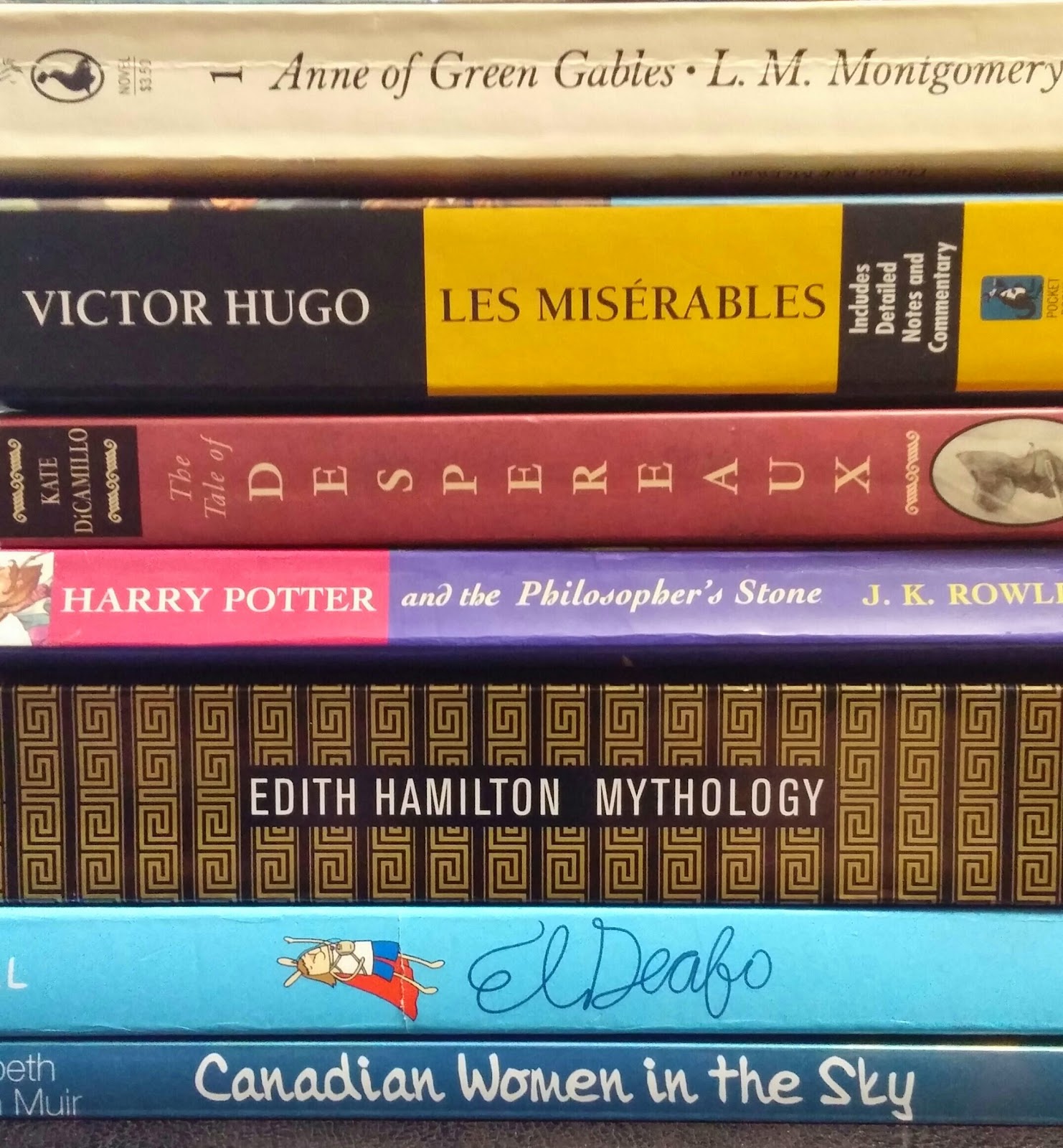
- I managed to sneak a few of my favorite books into the manuscript. All these books get a shout-out in MACY McMILLAN, either directly
or indirectly:

- I had the title several years before I had a story to go with it.
- The last poem in the book is my favorite (and it’s only one sentence).
To enter the giveaway, comment with one of your fave books—one that you’ve read and
re-read, one that you recommend all the time, one that you quote lines from at
inappropriate moments even if it causes people to look at you funny (“I solemnly swear that I am up
to no good"). So, yeah…comment with a fave book, and
please include your email so I can contact you if you win.
Good luck! And if you want to help spread the word and make this author super-happy, please share this post on social media, or add MACY to your Goodreads, or request it at your local library. Thank you so much! *passes you cookies*

Good luck! And if you want to help spread the word and make this author super-happy, please share this post on social media, or add MACY to your Goodreads, or request it at your local library. Thank you so much! *passes you cookies*

Shari Green writes
fiction for kids and teens. She lives on Vancouver Island, BC, Canada, with her
husband, kids, and the worst watchdog ever. Visit her online at www.sharigreen.com.
Subscribe to:
Posts (Atom)