Tuesday, August 30, 2022

AUTHOR INTERVIEW: ERIN ENTRADA KELLY, AUTHOR OF SURELY, SURELY, MARISOL RAINEY


You are in for another treat this week! 


Not only did I get a chance to read an advance reader copy of SURELY, SURELY, MARISOL RAINEY, but I got to interview Award Winning, Best-selling, author Erin Entrada Kelly!


You know her from her amazing books, including the following:


She's one of my favourite authors, so it was a real treat to ask her about her latest book, a chapter book that continues the adventures of Marisol Rainey, who is one of the most delightful characters you will ever meet.


About the book:


Everyone loves sports . . . except Marisol! The stand-alone companion to Newbery Medal winner and New York Times–bestselling Erin Entrada Kelly’s Maybe Maybe Marisol Rainey is an irresistible and humorous story about friendship, family, and fitting in. Fans of Clementine, Billy Miller Makes a Wish, and Ramona the Pest will find a new friend in Marisol. 

Marisol Rainey’s two least-favorite things are radishes and gym class. She avoids radishes with very little trouble, but gym is another story—especially when Coach Decker announces that they will be learning to play kickball.

There are so many things that can go wrong in kickball. What if Marisol tries to kick the ball . . . but falls down? What if she tries to catch the ball and gets smacked in the nose? What if she’s the worst kickballer in the history of kickball? Marisol and her best friend Jada decide to get help from the most unlikely—and most annoying—athlete in the world: Marisol’s big brother, Oz.

Told in short chapters with illustrations by the author on almost every page, Erin Entrada Kelly’s stand-alone companion novel to Maybe Maybe Marisol Rainey celebrates the small but mighty Marisol, the joys of friendship, the power of being different, and the triumph of persevering. Surely Surely Marisol Rainey is ideal for readers of Kevin Henkes, Meg Medina, Judy Blume, and Beverly Cleary.  


The Interview


1.     First of all, I adored SURELY SURELY MARISOL RAINEY!  It’s the perfect follow-up to MAYBE MAYBE  MARISOL RAINEY!


As a kid who often heard “Nice try”, I could one hundred percent relate to Marisol’s reluctance to participate in kickball!  For many kids who aren’t very athletic, gym class can be traumatizing. Did you pull on experiences of your own to make it feel so accurate?


Absolutely. Marisol is the closest autobiographical character I’ve ever written. Everything about her—except for some elements of her family dynamic—are all Erin. This includes the things she loves, like cats, silent films, and her best friend, along with all her fears and insecurities.


One of my biggest struggles growing up was being in the shadow of my older sister, who was more athletic and didn’t seem afraid of anything, much like Marisol’s brother Oz. With SURELY SURELY, I drew on my childhood fear of playing team sports. In my case, it was softball. I tried all these tricks to avoid going up to bat, like sneaking to the back of the line, but my time eventually came. I struck out the first time. The next time, I kept my eye on the ball and hit it. Not very hard, but I hit it. I made it to first base. Then the bell rang. I still remember what it felt like when the bat hit the ball. 


2.     I love the metaphor of a brain train — it’s the perfect way to describe how our thoughts can race and hurtle us down the tracks to places we really don’t want to visit. What I love about it especially in this book is that kids (and adult readers like me!) will really see themselves in Marisol. She’s a worrier, like so many of us. Why do you think it’s so important for kids to see beloved characters struggling?


We—and by “we,” I mean adults—often have an idealized concept of childhood. We grow up and suddenly all the problems we had as children seem small in comparison. But they weren’t small. And they certainly don’t feel small to the children experiencing them. Adults can be incredibly patronizing and condescending. When kids have crushes, we call it “puppy love.” When kids cry too easily, we say they’re “too sensitive.” We toss their problems aside and give them lectures about the “real world.” Their worlds may seem small and silly to us, but they’re very real. This includes their triumphs and their heartbreaks. Adults forget how difficult it is to grow up.


I still remember the first time I felt truly seen as a young reader—it’s when I read The Very Worried Walrus, which was part of the Sweet Pickles collection. I loved that Walrus. It was the first time I met a character who worried all the time, just like me. It made me realize I wasn’t alone.


3.     One thing I truly loved about the book was Marisol’s friendship with Jada. They so have each other’s backs, though they are human. How difficult is it to write realistic friendships?


If you’ve been fortunate enough to have wonderful friends, it’s not that difficult at all.


4.     Felix’s empathy for animals is both delightful and an amazing lesson in the book. As someone who is pretty sure the squirrel in her backyard understands her, inquiring minds want to know: do animals speak to you like they speak to Felix?


If I’m being honest, I do most of the talking. Ha!


5.     The illustrations are so good! Do you have a particular favorite?


My favorite is the final illustration of Marisol in bed with all her stuffed animals. It’s such an accurate depiction of how I fell asleep when I was her age. I slept with a mountain of them.


6.     When will we get to read more Marisol? She is a delight!


Yes! Another book will be out next year. 


Want to learn more about Erin and her books? Visit here!


Monday, August 22, 2022

Interview with Christyne Morrell, Author of TREX


Those of you who are fans of Christyne's last book, KINGDOM OF SECRETS,  are in for a treat! I had the opportunity to read an Advanced Reader's Copy and it is a PAGE-TURNER!


ABOUT THE BOOK


Trex’s experimental brain implant saved his life—but it also made his life a lot harder. Now he shocks everything he touches. When his overprotective mother finally agrees to send him to a real school for sixth grade, Trex is determined to fit in.


He wasn’t counting on Mellie the Mouse. She lives in the creepiest house in Hopewell Hill, where she spends her time scowling, lurking, ignoring bullies, and training to be a spy. Mellie is convinced she saw lightning shoot from Trex’s fingertips, and she is Very Suspicious.

And she should be . . . but not of Trex. Someone mysterious is lurking in the shadows . . . someone who knows a dangerous secret.


INTERVIEW WITH CHRISTYNE


Q:        First of all, I LOVED TREX! Can you share with our readers where the original idea came from? It is so good!

A.                  Thank you! This is a bit spoilery, but the idea came to me one night after a neighborhood party. I left early to put my daughter to bed and immediately fell asleep beside her. Being an introvert, all that socializing had worn me out! When people asked where I’d gone, my husband said I had to go inside and “recharge my batteries,” which got me thinking… what if I literally had to recharge my batteries? Then I took it a step further, envisioning a character who physically manifested the traits of an introvert. In addition to having to recharge, Trex is uncomfortable in social settings as a result of his condition, and because of his static shock, he keeps other people at a distance. The rest of the story came together from that initial spark (pun intended 😊). Needless to say, I’m so glad I ghosted that party!  

Q.        The characters of Mellie and Trex are so real. How much pre-work did you have to do before writing the book to really get your characters?

A.                  I didn’t do much character pre-work, unless you count awful early drafts! I’m a plot-first writer, so I always start by making detailed, beat-by-beat outlines of what’s going to happen. I know the basics about my characters when I start drafting, but I don’t really get them until I’ve had a chance to spend time with them, which usually happens around the third or fourth draft. Then, in drafts six or seven, I layer in all the little details I’ve picked up along the way, which hopefully make the characters step off the page. 

Q.        The multiple points of view — including some adults — is so well done and really adds to the plot twists. Was that always a decision from the get-go?

A.                  I’m a sucker for a multiple-POV novel (or a glutton for punishment), so yes, the three narrators were present from the beginning. It was challenging to juggle all those perspectives, but I wanted to examine the secrets people keep and the lies they tell (to themselves and to others). To do that, I had to get into the characters’ heads and let each of them have their say. 

Q.        If someone asked me to describe the story, I’d say Mission-Impossible-Meets-Harriet-The-Spy, how would you describe it?

A.                  Ooh, I like that! I usually describe TREX as a sci-fi-adventure mystery, because it contains a little bit of everything. As I was writing it, I was reminded of the classic 80s movies of my youth, like E.T. and Flight of the Navigator - stories about outcasts with abilities being exploited by big corporations. Or, more recently, the series Stranger Things, with the appearance of a mysterious newcomer who has unexplained powers caused, again, by an evil corporation (but minus the terrifying demogorgon). I’d also compare it to my favorite books with unreliable narrators, like Liar and Spy by Rebecca Stead. So some combination of all those things! 

Q.        There are a LOT of trust issues in this book and I love that, because learning who to trust and not, and learning to forgive others’ mistakes is so important for kids to learn.  Was that purposeful from the beginning or did it evolve as you wrote?

A.                  The trust element evolved organically as I wrote. From the beginning, I was focused on the twin ideas of secrets and lies, and I fleshed that out with three main characters who all have something to hide. I was particularly fascinated by Mellie, who “collects” other people’s secrets while simultaneously denying her own. That central theme naturally lent itself to an examination of trust and how it’s gained and lost - how being dishonest, even to protect yourself or someone else, can be harmful. I agree that this is an important topic for kids at this age, especially as it plays out in the parent/child relationship. There’s a line in the book that I wrote early on and kept returning to, which I think captures this concept well: “[He] has every reason to hate me. For all the secrets. For all the lies. And worst of all, for not knowing the difference between the two.” 

Q.        Likewise, anxiety is addressed so well. We really feel for Mellie. How much research did you have to do to get that so right?

A.        A lot! First, I read everything I could find about anxiety in kids; then I tried to balance the more clinical perspective with first-hand experiences - both my own and those that were shared with me. At the root of this story is my own background with introversion/anxiety, and as I began to circulate early drafts to friends and beta readers, I discovered that my experiences were not uncommon. The number of people who revealed that they and/or their kids mistook anxiety for gastrointestinal issues, or could otherwise relate to Mellie, made me more determined to get this book into the world. 

Interestingly, getting it “right” in terms of authenticity occasionally meant getting it wrong. At the beginning of the book, Mellie has a number of misconceptions about her anxiety and her medication. They’re corrected by the end of the story, but they reflect many of the personal experiences I heard. The same is true of the way Mellie’s parents approach her situation. They initially seek a quick fix for her anxiety but eventually realize that an honest discussion and acknowledgement of the issues are critical to a long-term solution. 

Q.        Tell me Mellie and Trex are going to be life-long friends!

A.              Absolutely! Mellie insists upon it, and she always gets her way. I picture them bickering and playing Alphabetter* for their entire lives!

*Alphabetter is a game in which you take turns naming your favorite things in alphabetical order, with extra points for multiple words starting with the same letter (e.g., chocolate chip cookies).   

Q.        Your first book, KINGDOM OF SECRETS, was a fantasy. TREX is a mystery/adventure story. What’s next?

A.        I’m working on a ghost story, believe it or not. My agent tells me I have “range,” which I think is a kind way of saying I have a short attention span. I love to explore new genres and styles with each book, but I try to incorporate a common spirit of adventure, friendship, and self-actualization into each one. Oh, and plot twists - those are my favorite! 

Thanks Christyne! 


ABOUT THE AUTHOR


Want to learn more about Christyne and her books? Visit here!


Tuesday, July 19, 2022

Interview with Mat Heagerty, author of Lumberjackula


What's it about:

Jack is in a pickle. His lumberjack mom wants him to go to Mighty Log Lumberjack Prep to learn how to chop wood and wear flannel. His vampire dad wants him to go to Sorrow’s Gloom Vampire School to learn how to turn into a bat and drink blood-orange juice. And Jack has a secret: what he really wants to do is dance.

When he finds out about Tip Tap Twinkle Toes Dance Academy from new friend Plenty, Jack feels he’s finally found the place where he can be his true self. But he’s too afraid of disappointing his family to tell them. What’s a half-lumberjack, half-vampire boy to do?

To summon the confidence to pursue his dreams, Jack will have to embrace every part of himself—his lumberjack toughness, his vampire eeriness, and most especially his awesome dance moves.


The Interview:


1.     First of all, congrats about Lumberjackula! I loved this book so much!  But before we get into specifics about the book, would love to know your path to becoming an author!  How did you break into writing comics and graphic novels?


Thank you so much, Wendy! Sam and I are so proud of how it turned out!


I’m dyslexic, and like many dyslexics, comics were a huge part of how I learned to read. The smaller text blocks and images to help with context clues where huge for me. After reading my first Calvin and Hobbesstrips, I started making my own comics and never really stopped. There were some years where making comics took a backseat to being in punk bands, but it’s never not been a part of my life. 


A big moment early on for me was when Andrew Clements (author of Frindle and a ton of other great middle grade books) visited my second-grade class that his twin sons were in. Seeing a real person who was telling stories for a living was massively impactful. 


For almost a decade, while bartending, I self-published, crowd-funded, and unsuccessfully pitched a ton of books to every publisher in comics with open submissions. I eventually got a miniseries published by this now defuncted and loathed small comics press-- it was a huge learning experience. Biggest lesson of all was that, as corny as it sounds, I found my voice. In that, the miniseries I made was not my voice at all. I realized that I really enjoyed writing for younger readers and that most of the stories I loved were lighthearted and goofy. 


So, I made a light-hearted and goofy pitch for a middle grade graphic novel and submitted it to just one published, Oni Press (a publisher who put out some of my favorite books) and they took it! From there, the doorway inched open a bit and I’ve been trying to force it all the way open since, now luckily with the help of my amazing agent Maria Vicente.  


2.     Is one genre easier than another, both to write and break into?


I feel like breaking in as a writer for either floppy monthly comics or graphic novels can both be equally soul-crushingly hard, hehe. As for me personally writing them, graphic novels are much, much easier. I like telling stories in big chunks with a beginning middle and end. The lack of pages and serialized structure of monthlies would be really hard for me, I think.


3.     How long does it usually take you to write a graphic novel? How much input do you get re: the illustrations?


It really depends on the project and how full my plate is with taking care of my young kids, but generally, I can have a book finished in about three months with my schedule. 


As for art input-- I’ve only made original books so far and not done any work-for-hire, so I’ve been lucky enough to have a say in picking everyone I’ve collaborated with. I’ll certainly write my ideas in a script and have some thoughts throughout the process of the book being illustrated, but I don’t get too involved because that’s not my job. I choose collaborators because I love what they do, so I try not to get in their way too much, hopefully!


4.     Team Marvel or Team DC (or maybe just Team Mat?)


Mat’s great for sure. He’s a nice dude. So, I’m Team Mat definitely, but I have lots of love for all comics! No one team for me! Marvel was a huge part of my childhood, specifically X-Men and Spider-Man, but DC was really big too with Legion of Superheroes, Young Justice, and Batman: The Animated Series.


5.     Where did the idea of Lumberjackula come from?


It started with an idea I had for just a vampire in middle school called Backpackula. Then I just really liked the way that mash-up sounded, but the idea seemed too simple. So, I tried out others like Quarterbackula, Jetpackula, and Quackula, but they were either taken already or not fun enough for me. I landed on Lumberjackula and the visual just really made me laugh. The character for sure came before the story.


6.     One of my favourite things about this book is that even though Jack’s parents are trying not to pressure him into favouring their choices over the other parent’s, he still feels pressure to please them both. That’s a thing that every kid goes through. Why was that important to you to show that to your readers?


When I was just starting Lumberjackula, I found a picture I had drawn when my wife was pregnant with our first kid. It was of what I thought my daughter would look like as an adult. Even though both my wife and I have always made it a priority to encourage our kids to be whoever they are, I realized I was still putting pressure on my daughter unknowingly. In the drawing, she dressed and looked like my wife pretty much and had a Star Wars shirt on and was holding a guitar. Even as well-meaning and innocent as that was, I realize if she saw the sketch, she would internalize that and think that’s what I want her to be. When the truth is, I want both my kids, or any kid, to be whoever they want to be. 


After that, I thought about how my big excitement when my kids express interest in drawing or music puts a pressure on them too. So, I really wanted to work out my thoughts on all that in the story, for young readers, but also hopefully for some parents reading along too. I hope a parent or two realizes, even if they aren’t forcing their kid to be on the football team, they can still be unknowingly pressuring them down a path they aren’t comfortable with.


7.     Jack’s mom is a lumberjack, his dad a vampire, so clearly he is a product of a mixed marriage, an issue you handle with sensitivity and creativity in the story. Can you talk about whether that was a conscious decision from the get-go?


First of, I’m so glad to hear you feel it was handled sensitively. It was for sure a major concern for me. Even though it’s a fantasy story, I see that the correlation is very easy to draw.


When I started, everything was simply, I think Lumberjackula is fun to say and I wasn’t giving the idea of that he was the child of a mixed marriage much thought at all. But as the story shaped it became a very clearly part of everything. As I’m not a member of a mixed family, I made sure to share my work along the way with my friends and extended family that are to make sure I was handling everything with the proper respect and authenticity. My editors were also massively helpful with this too. 


Also, I really tried more than anything to focus on Jack’s parent’s interests being different. Something I can relate to in my own family. While I have lots of crossover with my wife of course, there are some things we are both very passionate about that the other doesn’t have much interest in. So, I viewed Jack’s conflict a lot through that lens instead, if that makes sense? 


Totally does!


8.     Jack has a special calling all of his own, one he doesn’t feel comfortable sharing with people, even though it fills him with joy. We all want to feel seen, even as we all want to belong. How hard was that to write? You did such a great job!


Thank you so much! It wasn’t too hard to tap into at all. While there isn’t much that I’ve ever really felt I needed to hide, I certainly can relate to Jack’s anxiety and fear of disappointing people. I’ve struggled with confidence most of my life and have a pretty unhealthy need to be liked. Well, at least by folks I think highly of. So writing an nervous, insecure kid was all too easy for me!


9.     Just as his family makes mistakes, so does Jack. Can you tell our readers about how you decided what and where to include those mistakes in the story?


The mistakes Jack and his folks, and his grandparents all make just all seemed so natural for the plot to me. I think pretty much everyone has lied at one point or another to avoid difficult talks. Jack’s biggest mistakes—lying and his treatment of his new buddy Plenty—both just felt needed for conflict in the story. There’s one particular mistake in the third act, where Jack keeps up his lie even though it’s really obviously time to come clean. My editors suggested that in the last round of edits, and I’m so happy they did. I think it just felt there needed to be one last hurdle, the flow was off.


10.  Finally, I am in LOVE with Jack’s world! Any chance of more books? 


Oh man, I really, really, really hope so! I have ideas for so many more books. I have a pitch for a sequel that should be going out any day now that I’m very proud of. Fingers and toes majorly crossed that our publisher is interested!


11.  What’s next?


I think the next book to come out will be, a middle grade sports fantasy graphic novel I’m making with Lisa DuBois called Indoor Kid. It’s being published by Oni Press. The dates are moving still on a few books, so maybe something else might be out first. But besides that, I’m pitching and hoping folks let me make more books!


Thanks Mat! 


Thank you so much, Wendy! This was a lot of fun!


Want to learn more about Mat? Go here!

Wednesday, May 11, 2022

Interview with Bridget Hodder, Author of The Button Box

Author Interview: Bridget Hodder


I'm a huge fan of Bridget, and absolutely adored her first book, The Rat Prince, so I jumped at the chance to read The Button Box, her latest middle grade novel with the genius who is Fawzia Gilani-Williams!


Let me tell you: the book does not disappoint! I adored all of the characters, and learning about the real history behind the story!


About the Book


After Jewish fifth-grader Ava and her Muslim best friend Nadeem are called hateful names at school, Ava's Granny Buena rummages in her closet and pulls out a glittering crystal button box. It's packed with buttons that generations of Ava's Sephardic ancestors have cherished. With the help of Granny's mysterious cat Sheba, Ava and Nadeem discover that a button from the button box will take them back in time. Suddenly, they are in ancient Morocco, where Nadeem's ancestor, Prince Abdur Rahman, is running for his life. Can Ava and Nadeem help the prince escape to Spain and fulfill his destiny, creating a legendary Golden Age for Muslims, Jews and Christians?


The Interview


Q1: First: hooray for a new book by you Bridget! But would love to know how you and the wonderful Fawzia Gilani-Williams came to work together?


Thank you, Wendy! 


Fawzia and I have waited so long to bring The Button Box to the world! It's a cross-cultural tale of modern children --one Sephardic Jewish, one Muslim--who are magically transported by an antique family button into a shared ancient past, full of danger and challenges they must face with courage. The kids bring that courage with them back to the present, newly empowered to solve their own problems.


To answer your question about how Fawzia and I became co-authors, I have to tell a little story. 


I met Joni Sussman, the head of Lerner Books' Kar-Ben imprint, at the Highlights Workshop for Jewish kidlit writers. The workshop featured an opportunity for authors to read aloud from their works in progress. After I read a few pages from my first draft of The Button Box, Joni told me she would be interested in acquiring the book for Kar-Ben. I was thrilled, but I told her the tale would be undergoing some major changes, first. I needed a Muslim co-author to make the book become what it truly needed to be: a celebration of the intertwined elements of the Sephardic Jewish and Muslim past, brought into the present through genuine modern perspectives from both cultural traditions.


Joni suggested Fawzia Gilani-Williams, who she'd worked with before on the classic "Yaffa and Fatima: Shalom, Salaam"...and a beautiful partnership soon came into being. 


Q2: Is co-authoring a book harder or easier than writing alone?


I wouldn't say the writing process is necessarily harder when co-authoring, but it does take longer. To achieve the necessary balance of voices and material in the story, and to maintain a good working and personal relationship, much care and thought and extra time is required. You can't rush trust, and trust is the sine qua non of creating art together. 


Working across several time zones, with Fawzia in the United Arab Emirates and me in the U.S., it took at least a day to get a response to every email or draft. We put in the "plus time" to make sure we were both okay with every change, and that neither of us felt under- or over-represented in the story. 


On the other hand, a co-authorship offers remarkable creative and emotional support! Each of us knows exactly what the other is experiencing. We're able to compare notes and back up each other's opinions. And when an edit comes that is difficult to execute, we can share the burden. Probably the best advice I can give if you want a great co-writing experience is to have Fawzia Gilani-Williams as your co-author.


Q3: The book begins with Jewish Ava and Muslim Nadeem being bullied in school because of their religions. How hard was that to write? It is such a painful experience.


It was hard, because we were channeling current distressing trends of ever more open and aggressive hate against Muslims and Jews in the U.S. But this theme was central to our purpose in writing the book: to support those children who experience harassment; to give them courage; and to provide empathy and modeling that can create allies among the readership. 


To that end, we strove to create the most classroom-friendly book possible, with a historical map, a cross-cultural glossary, definitions and extra resources in the back matter, to aid teachers and students alike as they search for more knowledge on the subjects we raise. The team at Lerner Books and Kar-Ben was simply amazing in how they made our vision come alive in the pages of The Button Box.


Q4: The use of the button box is such a lovely and powerful way to talk about the importance of honoring our ancestors traditions and experiences. Was it always a button box or did you have other options? And, did your family have one?  


Oh, there was never any question...it was always going to be a Button Box. My mother and grandmother had button jars that I spent fascinated hours with in my childhood...and in my adulthood, too! I buy old button collections whenever I see a really good one at a thrift store or a swap meet and add the loveliest ones to my stash. It's amazing to see the craft of the handmade antique buttons, and the fine materials like mother-of-pearl, burled wood, shiny black jet and even genuine sea pearls.


Q5: I’d heard of Sephardic Jews, but knew very little about them, so I loved the history. I also loved how the story uses historical truths to show that our religious differences don’t have to divide us, but can in fact, can build new and wonderful traditions and beliefs if we’re open to that. Are other readers as surprised as I was by this amazing piece of history?


They are! Fawzia and I are bowled over by the reaction we've gotten from readers. They are so eager to explore new, exciting eras of history, and our work provides a window into brand new worlds for them. That's one of the valuable things diverse books can provide so easily and so well: a sense of discovery and of wonder at the many precious life-ways our world holds...like shining magic buttons in the Button Box, just waiting for you to be open to experiencing them.


Q6: What are you working on now?


Fawzia and I have a picture book coming out next year, in 2023, called THE PROMISE! Once again, Joni Sussman at Kar-Ben is our editor. We just received the breathtaking sketches for the illustrations from artist Cinzia Battistel, and we're floored by their beauty. 


We can't wait to share it with you soon!


THANK YOU, BRIDGET!


Want to learn more about Bridget? Visit her here!


Want to learn more about Fawzia Gilani-Williams? Visit her here!


Friday, March 11, 2022

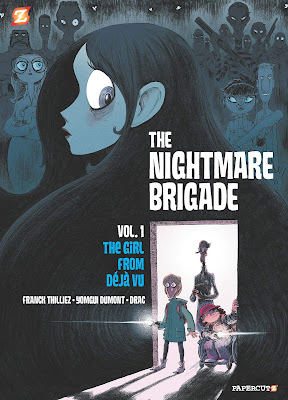
Review: The Nightmare Brigade, Vol. 1 by Franck Thilliez, Yomgui Dumont

The Nightmare Brigade is SUCH a cool book.


I love a good graphic novel and this one is GOOD, filled with twists and turns and lots of creepy and funny bits to keep the reader engaged. 


Synopsis:


The Nightmare Brigade is a dream team lead by Professor Angus. With his two young sidekicks, 14-year-olds Esteban and Tristan, they have one goal: help people vanquish their worst nightmares. With unique skills, the team members can literally infiltrate their patient's nightmare to seek its root and destroy the cause. Things are shaken up however, when they meet young Sarah. The Brigade has a feeling they have seen her before... Before they solve the mystery, an insomniac starts invading other people's dreams. How does he do it and how can he be stopped?


About the Author and Illustrator:


Frank Thilliez is the author of fifteen crime novels, and a screenwriter. 

Yomgui Dumont's worked in cartoons, multimedia, advertising, and the press, and has published more than twenty graphic novels and teen novels.

The book was released first in France and was very successful.


My thoughts:


As I said, this one is good. Esteban and Tristan are likeable characters who derive a lot of satisfaction from helping others. At school they may be bullied, but in the dream world, they're able to be heroes, which is a really interesting premise.

I also liked that Esteban is in a wheelchair in real life and how that plays into the choices he makes and how he behaves in the dreams.

As for Professor Angus, let's just say this: the guy is super mysterious, and readers are often left wondering about his (and other characters') motives, which makes this a great mystery.

And given that this is the first book in the series — Part Two Releases in June — the author leaves us with a real cliffhanger, which I love.

Kids and adults alike are going to eat this up, and there is lots of room here for MANY stories.


Want to Learn More?

Visit here.